Showing posts with label gemstone of the week. Show all posts

Tuesday, March 6, 2012

Amber is the Gemstone of the Week


Even though Amber is considered to be a gemstone, it is really fossilized tree resin that has been appreciated for it's natural beauty and color for thousands of years. Amber deposits have been found that range in age from 360 and one million years old. As resin oozed from now extinct conifer trees and pine trees, bits of plant life, insects and other small objects became trapped in it. As time passed, the resin became encased in dirt and debris and eventually fossilized. In order to be called Amber, the resin must be several millions years old. Recently hardened resins are called copals. Amber is perhaps one of the oldest gemstones used for human adornment. It has been found in European grave sites dating back to 8000 B.C..
Heating Amber will cause it to soften and eventually burn. if heated over 200 C, it decomposes, leaving behind a black residue known as "amber colophony" or "amber pitch", which, when dissolved in turpentine or linseed oil forms "amber varnish" or "amber lac".
Amber is found in many different colors. Besides the usual yellow-orange-brown that is commonly associated with the name Amber, it is also found in red, also called cherry amber, green amber and even blue amber, which is rare and highly sought after. The most highly prized Amber is transparent. Opaque Amber contains many tiny bubbles and is referred to as honey amber. Although all Dominican Amber is florescent, the rarest Dominican Amber is blue amber. It turns blue in natural sunlight or any other whole or partial ultraviolet light source. Only about 100kg a year are found which is the main reason it is so valued. Amber is a soft gemstone, on the Moh scale it is a 2 1/2-3 and care must be taken when wearing it to avoid scratching or chipping it. Quite a bit of the Amber found in jewelry today is reconstituted which makes a stronger stone. It is made by combining small bits of Amber with linseed oil, and compressing it. One way to tell if a stone is reconstituted is to look at the bubbles in it. Reconstituted stones have elongated bubbles, while natural stones have spherical bubbles. Sometimes the reconstituted Amber is called ambroid.

Gem quality Amber is most often from the Baltic Sea area. About 90% of the world's Amber supply comes from here. Baltic Sea Amber has a high market value. Amber is also found in the Dominican Republic, Russia, Myanmar (Burma), Germany, Romania, Sicily, and Malaysia.

Amber is said to bring wisdom, purification, energy and balance. It is believed to enhance calmness, patience, strength and healing. It is also believed that Amber draws negative energy out of the body and purifies the heart and spirit.

Blue Amber


Sunday, December 11, 2011

Zircon is the Gemstone of the Week


Zircon is considered to be one of the birthstones for those born in December. Although this stone has been known since the Middle Ages, the oldest known Zircons, from Western Australia are 4.4 billion years old. There are several theories as to where the name comes from, but the most common one is that it comes from Persian word "zargun" which means gold colored, even though Zircons come in several different colors. Clear or colorless Zircons can rival diamonds for sparkle and shine. They are often considered to be a cheap substitute for diamonds, but can often be a valuable gemstone.

Zircons are a dense gemstone which means that the carat size of this gemstone will look smaller than the same carat size of a different gem. It is a remarkable mineral in that it can be found in many different types of rock. It is one of the most widely occurring minerals and can be found throughout the world. On the Moh scale, it has a hardness of 7.5, so it is a fairly strong gemstone.


Natural Zircon comes out of the Earth in brown, yellow, green and bright red. Some of the trace elements that give the stones their color can sometimes be radioactive. These stones are heat treated and that can produce the much desired blue color, along with white, purple, colorless, orange an pink. Heat treating is the most commonly used enhancement for Zircons. It is done to stabilize the stones and for coloring. Heat treating semi transparent grayish brown and reddish brown stones in an oxygen free environment will give it a blue color. If the same stones are then heat treated with air, the color will turn golden brown. Almost all colorless and blue Zircons are heat treated.


Zircon occurs in beach sand in many parts of the world, especially in Australia, India and Brazil. Thailand, Cambodia and Viet Nam are major sources of Zircon. It can also be found abundantly in Sri Lanka, and Myanmar. It is also found in Quebec, Tanzania, Mozambique, Nigeria, Pakistan, Afghanistan, and Madagascar.


It is believed that Zircon helps one be more at peace with oneself, bring honor and and wisdom and to aid in peaceful sleep. It is also thought to promote inner renewal, foster independence, spirituality and friendliness, and bring inspiration.


Hindu poets wrote of the Kalpa Tree. This ultimate gift to the gods was a gemstone tree with leaves of green Zircon.


Natural Zircon
Photo courtesy of R.Weller/Cochise College

Blue Cambodian Zircon


Monday, November 28, 2011

Topaz is the Gemstone of the Week


Topaz is a gem of many colors, although the name is primarily associated with the color yellow. The gold or yellow topaz is considered to be a birthstone for November and the blue variety is considered to be the birthstone for December. Pure Topaz is colorless, with the other colors being created from impurities/minerals in the stone or enhancement of some type. The variety of colors, the strength, and a relatively good supply make Topaz a very popular gemstone. The name Topaz is believed to come from the Sanskrit word "tapas" which means fire.

Topaz is often found with flourite and cassiterite in various mountain areas including the Urals, in Russia, Afghanistan, Pakistan, Sri Lanka, the Czech Republic, Germany, Norway, Italy, Brazil, and Sweden. Some clear Topaz crystals from Brazil, which is the largest producer of Topaz, can reach boulder size and weigh hundreds of pounds. A Topaz called the American Golden Topaz weighs in at 22,892.5 carats.

Topaz is often called by many different trade names for the different color varieties. Some of those are Azotic Topaz, an orange pink stone with a rainbow color effect. It is synthetically colored by a thin film deposition of a thin metallic layer over the gemstone. It is named for the company that created this kind of finish-Azotic. London Blue Topaz is a deep sky blue color. It is darker than Swiss Blue Topaz. Mystic Topaz has a rainbow finish very similar to Azotic Topaz. Sherry Topaz has a light orange brown to brownish pink color. Silver Topaz or White Topaz are both trade names for the clear variety of Topaz.

Citrine can resemble Topaz and sadly, there are unscrupulous dealers who sell the less expensive Citrine as Topaz. Some of the names this false Topaz is sold under are Bahia Topaz, Citrine Topaz, Gold Topaz, Maderia Topaz, Spanish Topaz and Topaz Quartz. Smokey Topaz is really Smokey Quartz, and Indian Topaz, King Topaz and Oriental Topaz are really orange yellow Sapphires. As with any gemstone purchase, do your research and find a reputable dealer to buy from.

It is believed that Topaz balances emotions, calms passions and releases tensions. It is also believed to inspire leadership abilities and spiritual growth.

This is the American Golden Topaz which is on display in the Smithsonian. On the left is the Lindsay Uncut Topaz which weighs 70 pounds. On the right is the Freeman Uncut Topaz which weighs 111 pounds. They are also in the Smithsonian.


.


Sunday, November 13, 2011

Citrine is the Gemstone of the Week

Citrine, a beautiful gemstone ranging in shade from yellow to gold to orange is one of the birthstones of November. A member of the quartz family, the name comes from the Latin word "citrina" which means lemon. The color comes from the presence of iron.


Natural Citrine, which is a pale yellow color, is not common. It is sometimes marketed as Lemon Quartz. Most of the Citrine on the market today is heat treated Amethyst or Smokey Quartz. The color can be changed by heating to a relatively low temperature-around 750 degrees Farenheit and the darker colors can be achieved by heating to around 1700 degrees Farenheit. Almost all heat treated Citrine has a reddish tint to it.


Brazil is the main source of Citrine, with other deposits being found in Argentina, Madagascar, Zaire, Namibia, Spain and Russia. On the Moh scale, it has a hardness of 7. Flawless stones of many carats are not uncommon with the gemstone.


Citrine is most often confused with orange-yellow topaz which is very similar in color. Topaz is the more valuable stone and sometimes, unscrupulous dealers will pass Citrine off as topaz. Some of the more common trade names for these gems are "Madeira Topaz", "Gold Topaz" and "Bahia Topaz".
 

Citrine's sunny color has given it the reputation of being a gemstone that radiates positive energy and one that dissipates negative energy. It is also known as the "success stone" because it is believed to promote success, prosperity and abundance, especially in business. It is also believed that Citrine will relieve depression, self doubt and anger and can reduce self destructive tendencies. It is also believed that Citrine can aid in sleep disturbances, digestive and thyroid problems, and strengthen the immune system. Citrine is also believed to be valuable in healing the spiritual self and to enhance the enjoyment one gets from life.
 
This is a picture of the largest cut Citrine in the world. It weighs in at a whopping 20,200 carats. Itis on display in Malaga, Spain in a special exhibition of rare gemstones.


Monday, October 31, 2011

Ametrine is the Gemstone of the Week

The name Ametrine comes from a combination of Amethyst and Citrine, which is exactly what Ametrine is. The color is the result of iron in the quartz. Ametrine colors come in bands of yellow and purple and often show and abrupt color change in the stone. This is the only stone where you can get “two” gemstones for the price of one.

There is only one basic source for Ametrine and that is the Anahi Mine in Bolivia. In the seventeenth century, this mine became famous when a Spanish conquistador received the mine as a wedding gift when he married Princess Anahi of the Ayoreos tribe. He knew the unique gemstones would find favor with the Spanish queen, and introduced Ametrine to Europe. The mine has only been commercially worked since the 1980's.
Being a member of the quartz family, it is a fairly durable gemstone. On the Moh scale, it has a hardness of 7. Ametrine is typically cut to give a 50/50 color split. It is popular among among gemstone cutters and carvers because of the color variations and play in the stone. Despite the fact that there is only one source for this beautiful gemstone, it is reasonably priced.


Ametrine is rarely enhanced, but if it is, it is enhanced by a heat treatment. Natural Ametrine only comes on purple and yellow, so if you see some blue-yellow or geen-yellow combinations being sold, be aware that they are synthetic, lab created stones.

It is believed that Ametrine helps achieve a balance between the spiritual world and the material one, and can enhance cooperation with others. It is alsosaid to help with headaches and backaches. It is also said that the purple part of the stone helps one visualize the future one wants, while the yellow part of the stone helps achieve those goals.

I don' thave any Ametrine to photograph and show you, and I couldn't find any photos to include that wouldn't violate somebody's copyright, so here is a link to page of Google Images for

Thursday, October 13, 2011

Opal is October's birthstone and the Gemstone of the Week

Opal is the featured gemstone this week, because it is also the birthstone for October. Often called nature's fireworks, this gemstone is composed of hydrated silica. Since the structure is not truly crystalline, it is considered a mineraloid, rather than a mineral. Opal has the same chemical composition as quartz, but has a water content between 3% and 21%, although the average water content is between 6% and 10%. Fine examples of opal can be more valuable than diamonds. It is a somewhat soft stone. On the Moh scale, it has a hardness of 5.5-6.5.

The internal structure of opal makes it defract light and, depending on the conditions in which it was formed, the stone can take on many colors. These colors can range from clear, white, gray, yellow, orange, green, blue, magenta, rose, pink, slate, olive brown and black. Red hues against black are the most rare, with white and green being the most common. The iridescent color flashes, are called opalescence, and change depending on the angle from which the stone is viewed.

Most opal is over 60 million years old, which dates it back to the time when dinosaurs roamed the Earth. Opal has been considered a gemstone since Roman times when it was considered to be second in value only to emeralds. The name, “opal” probably comes from “upala”, the Sanskrit word for precious stone.


Opals are usually sold in one of three ways. The solid gemstone by itself, although it is usually enhanced by some type of wax treatment to protect it from drying out. Opal doublets are thin slices of opal glues to a base material such as ironstone, basalt or obsidian. The darker color backing emphasizes the play of colors in the gemstone. Opal triplets are doublets topped with a domed cap of clear quartz, resin or plastic. This protects the relatively soft stone from scratches, while magnifying the play of colors in the stone.


Opals are most commonly from Australia, but are also found in the Czech Republic, Turkey, Indonesia, Brazil, and in the United States, in Nevada. In 2008, NASA also announced that they had found opal deposits on Mars.


Opal is believed to aid in the healing of eye diseases, enhance creativity, and to foster love and warmth. The ancient Romans considered the stone to be one of good fortune, while the Russians considered it to be bad luck. Queen Victoria loved opals and she and her daughters created a fashion trend for opal jewelry.
div style="margin-bottom: 0in;">


Rough opal from a Nevada mine

The Queen's Opal weighs in at 203 carats or 41 grams.

Saturday, July 30, 2011

Coral is the Gemstone of the Week

Coral is the gemstone of the week, even though it is not a mineral gemstone, but rather a macrobiotic substance formed from small plant like sea life. Most commonly found in red, pink (angel skin) and white, coral also occurs naturally in blue, orange, violet, red, gold and black. The ox-blood red coral is the color that is most valued for jewelry. Coral that comes from Italy is said to be the best quality.

The basic composition of coral is calcium carbonate with a little magnesium and a trace of iron. It is semi-translucent to opaque and is relatively soft. On the Moh scale, the hardness is 3.5 to4. Coral is actually the skeletal remains of marine polyps. The polyps are surrounded by a fleshy skin and secrete a substance that allows the coral to grow. Over the centuries, the names that different corals are given have been based a lot upon their shapes. Bamboo coral resembles bamboo shoots, brain coral, the human brain, mushroom coral, mushrooms, sponge coral, sponges and so on.

Coral is found in many parts of the world. The best quality red coral is found in the Mediterranean Sea, the the Red Sea and the sea around Japan. Pink coral, or angel skin coral, is found in limited amounts in the Mediterranean area, China, India and Japan. The pink Hawaiian coral is also quite well known. Blue coral is found in the sea around the Philippines. Black coral is found around Hawaii, Australia, the West coast of Africa and parts of the Mediterranean. There is not much demand for the blue and black kinds, so the price for those is not as high as the prices for red and pink coral.

The most common enhancement for coral is dying. This is done to either change color or to make the color more uniform. Sometimes it is bleached. Coral is often filled and coated with an epoxy substance to fill cracks and cavities.  

Many species of coral are endangered, but not all of it. Some coral, like bamboo and sponge coral are farm grown specifically for the market place. They are fast growing corals that are harvested in shallow water farms which makes them a sustainable resource. Global warming, pollution and harvesting for aquariums are the major causes of coral depletion.
Another form of coral that is popular for jewelry is Fossil Coral. Since that is a whole different variety, I will use another post to talk about that.

It is believed that coral can aid in the healing of lung, stomach and heart problems and help with circulation issues. It is also said that it helps in the development of courage, initiative and vitality.  

Mushroom coral and Bamboo coral


Monday, July 11, 2011

Ruby is the Gemstone of the Week

Ruby is the birthstone for July and is the gemstone of the week. Rubies are the most famous red gemstone. Ruby is the red variety of the mineral corundum (aluminum oxide), which technically makes it a red Sapphire since Sapphires are the other mineral/gemstone made from corundum. Since Rubies have such a special allure and historical significance, they have always been classified as a seperate gemstone and never as a Sapphire. The red color is determined by the prescence of the element chromiun. The name, Ruby, comes from the Latin, “ruber”, meaning red. Pigeon Blood red is the most valuable color in Rubies. The finest Ruby color is described as being a vivid medium dark toned red. These are found in Myanmar (formerly Burma) and have a bluish hue to them. The first laser was created using a Ruby.
On the Moh scale, Rubies have a hardness of 9. Among natural gemstones, only moissanite and diamonds are harder. All natural Rubies have imperfectons in them, including color impurities and rutile needles known as “silk”. These needle inclusions help distinguish natural Rubies from simulated or synthetic stones. The color is determined by the amount of chromium and iron in the stone. There are also Rubies that are called Star Rubies. These stones have rutile needles in them that form stars, also called asterism. Stones like this are cut into cabochons, while other Rubies are often faceted.
Almost 90% of the Rubies on the market today have undergone heat treatment ,which is the most common form of enhancement. This dissovles the silk inside and improves the color. These heat treatments are done with temperatures around 1800C or 3300F. Another treatment that has been used in the last several years is lead glass filling. It's a four step process that fills the fractures inside the stone with lead glass, making a previously unsuitable stone suitable for jewelry. It's possible to find high quality gemstones that have not been enhanced.


Rubies are found in Myanmar, Thailand, although production is declining there, Madagascar, Tanzania, India, Afghanistan, Cambodia, Viet Nam and Kenya. The color varies depending on the country of origin.
Famous Rubies include the 167 carat Edwards Ruby on display in the British 
Museum of Natural History, the 138.7 Rosser Reeves Star Ruby, which is in the Smithsonian, and the 100 carat DeLong Star Ruby on display in New York at the Natural History Museum. Rubies have long been a part of royal insignia and other famous jewelry. Some famous large Rubies in the British Crown Jewels, the Black Prince's Ruby and the Timur Ruby are actually spinels. Up until the 19th century, spinels were belived to be Rubies.

There are many beliefs and legends about this gemstone. Rubies have long been considered a stone of love and passion. It is believed that the person who wears a good quality Ruby will have a life of peace and harmony, protected against danger and blessed with good health. It is also believed that the stone aids in the healing of peptic ulcers, depression, fever and gout.


This photo is the Rosser Reeves Star Ruby.

Tuesday, July 5, 2011

Flourite is the Gemstone of the Week

Flourite has been nicknamed “the most colorful mineral in the world.” It comes in a range of sparkling colors from purple, blue, green, yellow, colorless, brown, pink, black to reddish orange. Intermediate pastel colors can be found in between the colors in some stones, also. Some Flourite is a single color, but most have multiple colors arranged in bands. A now scarce variety of purple blue Flourite, known as Blue John, is found in one of the oldest known localities for the gemstone, Castleton, Derbyshire, England. It is still mined there, but only a few tons per year.
Flourite was first called flourspar. Flourite derives from the Latin noun, “fluo” meaning stream or flow. Flourspar comes from the German “flusse” meaning stream and “spaerstan” meaning spear. It is a relatively soft stone, a 4 on the Moh scale. It is composed of calcium flouride.
Flourite is a widely occuring mineral found in large deposits in many areas of the world. Deposits are found in China, Austria, Germany, Switzerland, England, Norway, Mexico, Kenya, and Ontario, Newfoundland, and Labrador, in Canada. In the United States, deposits have been found in Missouri, Oklahoma, Illinois, Kentucky, Colorado, New Mexico, Ohio, New Hampshire, New York, Alaska, and Texas. In 1965, Flourite was named the state mineral of Illinois since at that time, Illinois was the largest Flourite producing state in the U.S.. In 1995, the last Illinois mine was closed.
Besides being used as a gemstone, Flourite also has industrial uses depending on which of the three purity grades it is. Metallurgical grade Flourite, the lowest grade has been used a flux to lower the melting point of raw materials used in steel production. Ceramic 
grade, the middle level of purity, is used in making opalescent glass, enamels and cookware. The highest grade, which is 97% pure, is acid grade Flourite which is used to make hydorgen flouride and hydorflouric acid by decomposing the Flourite with sulfuric acid. There is also synthetically grown Flourite which is used instead of glass in some high grade telescopes and camera elements.
When it come to the metaphysical aspect of Flourite, it is believed that Flourite opens pathways of the brain to higher dimensions of light, increases alertness and mental activity and helps in grasping complex and abstract concepts. It is also thought to bring in objectivity and concise thoughts, action and behavior.

These photos show some of the different colors, and the banding of Flourite.


Tuesday, June 21, 2011

Tiger's Eye is the Gemstone of the Week

The gemstone of the week this week is Tiger's Eye. There are several variations on the name, among them Tiger Eye and Tigereye. All the names refer to the silky, golden brown gemstone of the quartz family. It is a brown quartz silcon dioxide with yellow and brown parallel fibers. Iron oxide gives the stone it's yellow gold color. The glitter on the surface of the stone is known as chatoyancy (sha-toy-ancee).
Tiger's Eye is a vitreous stone-hard, unbendable and glasslike. On the Moh scale it is a 7. This makes it suitable for all types of jewelry, although care should be taken against exposing it to sudden temperature changes, as that could cause the stone to crack.

Tiger's Eye is usually cut as cabochons as this best shows off the chatoyancy and color. Heat treatment is the usual enhancement for this gemstone. Red Tiger's Eye is heat treated. The heat oxidizes the iron and turns it red. Years ago, I had some Tiger's Eye stones. My mom and I put them on a cookie sheet, in a 325 degree oven for 12 hours and they turned a lovely red. To prevent cracking,we did not preheat the oven, but put the stones in the oven, then turned it on, allowing the stones to gradually warm. Every couple of hours, we would turn the stones with tongs. We also left them in the oven to gradually cool down after we turned the oven off.
Tiger Eye is mainly found in South Africa, but is also found in Austrailia, Myanmar, Namibia and California.
Tiger Eye is said to help lower blood pressure, help with asthma and heart disease. It is also believed to pull someone into a more flexible and positive attitude and give the wearer courage and confidence. Roman soldiers often wore carved Tiger Eye into battle.

In these photos, you can see the different banding and how each stone varies.


Wednesday, June 8, 2011

Moonstone is the Gemstone of the Week

Moonstone, the gemstone of the week, is also the European birthstone for June.  This mysterious beauty has been used for jewelry since before AD 100. The ancient Romans believed that is was created from the solidified rays of the Moon. It is considered to be the second birthstone for the month of June. During the Art Nouveau period, this was a very popular gemstone. Famous jewelry houses such as Cartier's and Tiffnay used it in a lot of their pieces.
Moonstone is a member of the feldspar family, and is a potassium aluminum silicate. It is an opalescent stone and, like Labradorite, has flashes of color called schiller. In Moonstone, schiller is more often called adularescence-a billowy, floating color effect. It comes from the word “adularia” which was the first name for this gemstone. It was called after the first place moonstone was found, Mt. Adular, in Switzerland. Adularescence is created when light falls between two layers of feldspar that have intermixed, causing the light to scatter, producing the schiller effect.
On the Moh scale, Moonstone is a 6-6.5. The colors can range from blue, peach, green, pink, yellow, brown or gray, all with a silvery sheen. Rainbow Moonstone is a milky white with a rainbow sheen. The most valuable moonstone is one that has a colorless, transparent to semi-transparent appearance with a vivid blue adularescence. Ideally, the sheen should be centered to the top of the gemstone. Moonstone is found in Brazil, Madagascar, Europe, Myanmar, Tanzania, and in the U.S. in Pennsylvania and Virgina. The highest quality gemstones come from Sri Lanka. They are most often cut in cabochons to best display their adularescence.
Moonstone is believed to refresh memory, soothe and balance emotions and act as a digestive aid. It is also believed to heal strife between lovers and awaken passion.

Here are some of the moonstones I have.
Rainbow briolettes, rainbow faceted beads, peach, rainbow, white and gray and faceted peach beads.


Thursday, June 2, 2011

Pearls are the Gemstone of the Week

 
The birthstone for June, Pearl, is the gemstone of the week. This precious gemstone has been used in jewelry and ornamentation for centuries.
Most gemstones are minerals, but Pearls are organic and formed by living organisms. They are formed in the soft tissue layers of mollusks, such as oysters and mussels and begin forming when an irritant such as sand, gets inside the shell. They are made of calcium carbonate and organic conchiolin, that build up as concentric layers . (If you cut a pearl in half, the inside layers would resemble tree rings.)This is done in order to protect the inside of the oyster or mollusk from the irratant. This process can take anywhere from 4 months to 7 years. The longer it takes, the larger the pearl.


There are two basic kinds of Pearls-natural and cultured. Natural pearls occur in nature without assistance from humans and are very rare and because of the rarity, they are very expensive. Cultured pearls are created when humans insert the irritant into the shell. Cultured pearls are grown on pearl farms where they are cared for while the pearl grows. Some pearls are started from an irritant type of nucleus, some, like the Akoya pearl, are formed around a bead nucleus. Only one out of four cultivated mollusks lives to grow a marketable pearl. Since natural pearls are so rare, it is safe to assume that most pearls on the market today are cultured. Pearls are among the softest gemstones on the market. On the Moh scale, they are only 2.5.
The most valuable pearls are perfectly symmetrical, fairly large and naturally produced. They have a shimmering iridescence which is called orient. I've listed a few of the more common terms used for 
pearls. Baroque pearls have an irregular shape. Biwa pearls are from the freshwater lake, Lake Biwa, in Japan and also have an irregular shape. Blister pearls grow attached to the inside of the shell. Freshwater pearls grow in freshwater mollusk and resemble puffed rice. Mabe pearls are cultivated blister pearls. Oriental pearl is another name for saltwater pearl.
Pearls are often enhanced by dyeing. They are very porous and accept dye well. It is the easiest, and least expensive way to get a matched strand. One drawback to this is that the dye can fade over time. They can also be bleached to increase their whiteness. Irradiation darkens the nucleus of the pearl to produce darker pearls like blue gray and black. Most experts believe this to be permanent. Metallic pearl colors are often both dyed and irradiated. As a general rule, all bright or striking pearl colors are dyed or enhanced in some way.
Pearls are found in Japan, China, Tahiti, Ceylon, Scotland, Norway, Australia, Indonesia, the Gulf of Mexico, and Myanmar. The finest Oriental Pearls are found in the Persian Gulf.
It is believed that Pearls help people see themselves, and eliminate emotional imbalances. They are also thought to give wisdom through experience. Ancient Chinese myths told of pearls falling from the sky when dragons thought. The ancient Greeks thought that pearls were the tears of the gods.

These photos are some of the Pearls I have in my gemstone stash.

 Faceted Pearls
 Keishi Pearls
Pale Pink Pearls

Friday, May 27, 2011

Sunstone is the Gemstone of the Week

The sparkling gemstone, Sunstone is the gemstone of the week. Sunstone is a member of the feldspar family. When veiwed from certain angles, it has a brilliant, spangled appearance. This optical effect can be from tiny scales of red hematite which are irregular in shape. This gives it a look similar to aventurine and it is sometimes called aventurine-feldspar. Some crystals contain pyrite which gives it an extra flash of sparkle. Darker stones contain copper. Sunstone is formed in molten lava and then thrown out to earth by a volcano. As the lava weathers, or breaks up, Sunstone crystals are released. It is a sodium calcium aluminum silicate.

Sunstone is a relatively hard stone with a hardness that varies from 6-7.2.. Also called, Heliote, which comes from the Greek word “helios” and “lithos” meaning stone, Sunstone is the state stone of Oregon.

Sunstone was not common until recently, when, in the 80's deposits were found in Orgeon. It has also been found in Norway, Siberia, India, Canada, Russia, Pennsylvania, and Delaware. Oregon Sunstone is the only variety that contains copper inclusions.

The Vikings considered Sunstone to be a talisman for navigation and this gem has been found in Viking burial mounds. Sunstone is believed to bring luck, instill optimism and boost the energy level. It is also believed to boost physical energy in times of stress or illness. It is said that Sunstone also inspires freedom and originality.


These pictures are some of the Sunstones I have. I love the peachy tones this stone has.

Friday, May 20, 2011

Sodalite is the Gemstone of the Week

Sodalite,an opaque, royal blue gemstone with white streaks, is often confused with Lapis Lazuli. It is one of the minerals that makes up Lapis. The chemical compostion of Sodalite is sodium aluminum silicate chloride. The chloride is what differentiates this from Lapis. Lapis contains sulphur. There are two ideas for where the name comes from-one is for the sodium content and the other is from the Latin word “solidus” for solid, since it was a solid used in the process of glass making. It will fuse to a colorless glass if heated to a high enough temperature.
Sodalite is a hard mineral, yet because of the crystal structure, fragile with a hardness on the Moh scale of 5-5.6.
Sodalite is sometimes referred to as Princess Blue after Princess Patricia, granddaughter of Queen Victoria. She fell in love with this gemstone after a visit to Ontario, Canada and used it to decorate Marlbourough House in England. Sodalite has been discovered in ancient ruins and tombs in ornamental forms. It was often used as a substitute for Lapis Lazuli.
Signifiacant deposits of Sodalite are found in Bancroft, Ontario, Mont-St-Hilaire, Quebec, Lichtfield, Maine, and magnet Cove, Arkansas. Smaller deposits are found in Brazil, Bolivia, Portugal, Romania, Burma, and Russia.
It is believed that Sodalite was used by Egyptian priests to dispel fear and promote a clear insightful mind. It is also believe to help with a wide range of physical aliments from diabetes, and digestion issues to thyroid problems. It is also thought to be a soothing stone and to instill confidence.

Monday, May 9, 2011

This week Serpentine is the Gemstone of the Week

Serpentine is the name given to a large variety of rock forming minerals that are green, yellowish green, or brownish green in color. There are over twenty varieties of Serpentine and they are not always easy to tell apart. All Serpentines are a basic magnesium silicate. The name comes from the Latin “serpentinus” meaning snake rock. The mottled colors do give it the appearance of snakeskine. In mineralogy and gemology, Serpentine is divided into three groups, antigorite, chrysotile and lizardite.


Serpentine ranges from opaque to translucent and the Moh scale hardness varies within the different varieties. On the Moh scale hardness ranges from 2.5 to 5.5. Antigorite is the hardest variety. Serpentine is often streaked with the minerals calcite and dolomite. These minerals are what give Serpentine the white and gray streaks.


Several trade names have been given to Serpentine to distinguish the different varieties. These are bowenite, connemara,verde-antique and williamsite. It is often sold under the names of new jade, lemon jade, olive jade, Afghan jade and green jade. When buying, this is something you need to be aware of as these stones are not jade at all, but Serpentine.
Serpentine is found in many places around the world, including Afghanistan, Burma, China, New Zealand, Canada, the United Kingdom, Greece, Italy, Norway, and the U.S.. In the U.S. it is found in Northern California, Rhode Island, Conneticut, Mass., Maryland and southern Pennsylvania.
It is said that Serpentine can restore self confidence, repel fear, and enhance meditation. It is also believed to bring good luck and to help people obtain their dreams.
This Serpentine piece is in a necklace I made. It is a yellowish green, almost chartreuese color.

Friday, April 29, 2011

Kyanite is the Gemstone of the Week

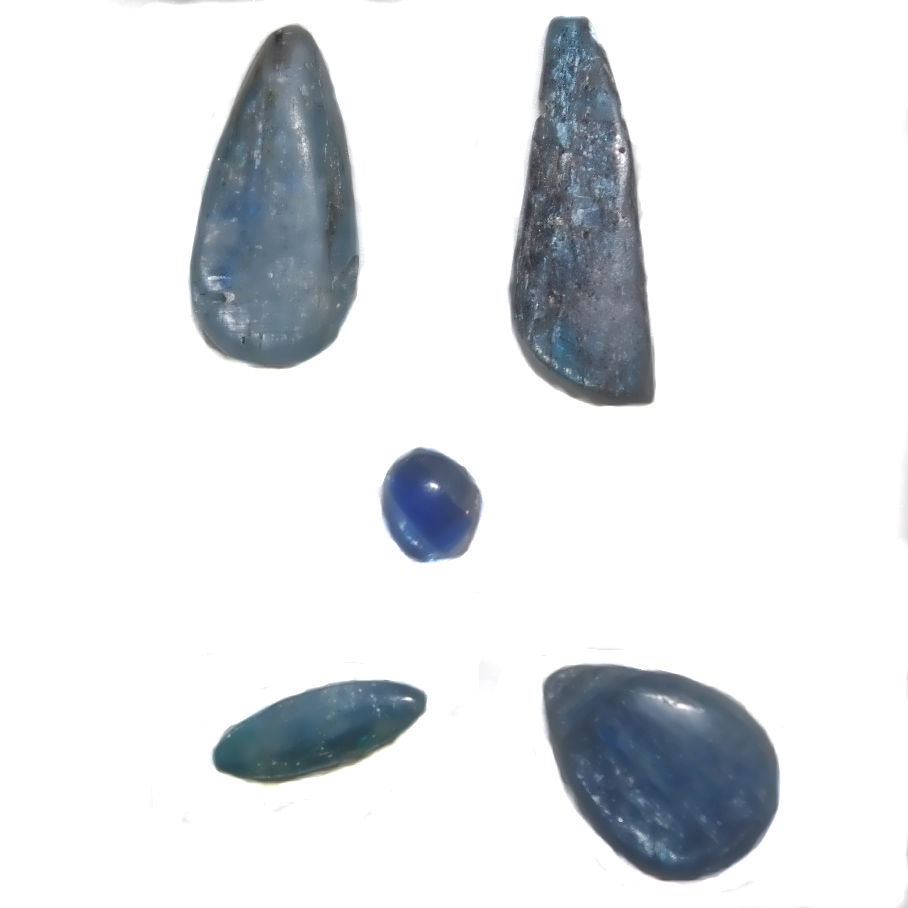
This sapphire blue, shimmery, multi purpose gemstone with unusual properties, is the gemstone of the week. For many years, this stone was considered more of a mineral than a gemstone. The name comes from the Greek word, “kyanos”, meaning dark blue.
Kyanite is unusual in the fact that it has the same chemical compostion as andalusite. Both are aluminum silicate, but have different crystal structures. In addition to being used for jewelry, kyanite is also used in industrial applications including spark plugs, electrical insulators and heat resistant ceramics to reduce the shrinkage as it expands.

Kyanite has been mined for about a century, but little is known about it's history. The color of Kyanite is not always uniform and can be blotchy and streaky. The crystals can be transparent to translucent and the crystals are found in long blades or columns. The stone can also be found in green and black and occaisonally, rarely, yellow, white and gray. Depending on which way the crystals are cut in a particular stone, the harness on the Moh scale can range from 4.5-6.5. The blue color comes from trace elements of iron and titanium. Green Kyanite gets the color from vanadium. Faceted Kyanite is a rareity. Because of the hardness variations in each stone, this complicates the faceting process.
Interest in Kyanite as a gemstone has been low, mostly due to the lack of sufficient supplies of gem quality rough. A recent find of gemstone quality rough in Nepal will probably raise the interest in this beautiful stone. Other sources of Kyanite are Austria, Brazil, India, Myanmar, Serbia, Switzerland, Namibia, and California. California has mostly green Kyanite.

It is believed that Kyanite is the stone of channeling, altered states, vivid dreams and dream recall. It is said that it will protect the wearer during these states. It is alos believed to bring loyalty, tranquility and honesty to the wearer.
The photos below are different color ranges of Kyanite that I have in my collection.

Friday, April 22, 2011

Turquoise is the Gemstone of the Week

Popular for thousands of years, Turquoise is the gemstone of the week this week. The popularity of this gemstone goes back to the ancient Egyptians and continues up through today. One thing that could account for the popularity is the fact that it is readily available and reasonably priced. Depending on the source, prices per carat can range from $1 to $50. Along with Zircon, it is the birthstone for December.

It is believed that the name, Turquoise, comes from the French word “pierre turquoise” meaning Turkish stone. That is a reference to the fact that Turquoise was brought to Europe from Persia by Turkish traders. For centuries, Persia (Iran) produced the most valuable Turquoise. Now, some Turquoise mined in the Southwestern U.S. compete easily in value. The term Persian Turquoise is used today to refer to stones that do not have the black or brown veining commonly found in U.S. stones.

Turquoise is an aluminum phosphate mineral. Bluer stones have a higher concentration of copper to give it it's coloring while greener stones have a higher concentration of iron or chromium. Since the soil makeup surrounding Turquoise deposits influences color, the location name is often included in the stone name. A perfect example of that is Sleeping Beauty Turquoise from the Sleeping Beauty Mine in Globe, Arizona.


Turquoise is a relatively soft stone-between 5 and 6 on the Moh scale, and is usually enhanced somehow. There are many ways of doing this. I have covered some of the more common processes and names of Turquoise on the market today.
     Foutz Enhanced Turquoise is the name for stones that have been treated by a process that impregnates and hardens the stone with vaporized quartz. This treatment is not detectable by normal testing methods. It is used on high to medium grade stones and will not work on low grade stones.

     Stabilized Turquoise has been treated with a plastic resin that allows lower grade stones to be suitable for using in jewelry.

     Wax treated turquoise works like stabilization and in the past, most Chinese Turquoise was treated this way. Today, most Turquoise from China is resin stablized since they have learned the process.

     Reconstituted Turquoise is mostly all man-made and should be labeled as imitation.

     Compressed nuggets are pieces of Turquoise that are bound with dye and resin. If you cut a piece of compressed Turquoise in half and look at the cross section, you can see the individual pieces of nuggets that were joined together.

     Chalk Turquoise is true, light blue, soft Turquoise that must be stablized to be used in jewelry. Today, there are some dyed stones that are passed off as Chalk Turquoise.

     Imitation and simulated Turquoise are stones that are made or dyed to look like Turquoise. Ceramic, polymer clay, glass and plastic are most often used for imitation Turquoise. Some of the more common stones that are dyed to create simulated Turquoise are Howlite, Magnesite and Dolomite.

     Do your research before you buy so you get what you pay for. Descriptive names are often used despite the chemical composition of the stone.

Turquoise today comes from several sources. In the U.S, Arizona, New Mexico and Nevada are the source. Other sources include, China, Mexico, Tibet, Iran, Peru, Africa, Austraila, Europe and Siberia.


It is believed the Turquoise has many powers. In ancient Persia, it was believe that if the stone changed colors, it was a warning of impending danger. It was often used to ward off the evil eye. Many cultures have held the belief that it is a good luck talisman. It's said that Turquoise enhances self confidence, and provides a sense of unity with one's self. Crystal healers recommend it for detoxifacation from alcohol, poison or radiation.

Here is a link to the Tantalizing Turquoise Collection I curated to go with this post.

Sunday, March 27, 2011

The Gemstone of the Week is Rhodonite

The gemstone of the week this week is Rhodonite. This beautiful pink and sometimes red gemstone is well known among collectors. The red variety can often rival ruby in the intensity of color and is the most highly prized. This rare, classic type of Rhodonite was once found in Franklin, New Jersey. The name Rhodonite comes from the Greek word, rhodos, meaning “rose colored”. It is opaque and often called Pink Marble.
It is classed as a silicate mineral and is associated with black manganese minerals, pyrite and spessartine.

The chemical make up of Rhodonite is manganese iron magnesium calcium silicate.
Rhodonite often has impurities of black manganese veins running through it in crisscrossing lines. These are called dendrites. The black against the pink gives it a nice contrast. This is the most common kind used for beads and jewelry. It is a relatively inexpensive gemstone. Rhodonite is usually not enhanced in any way expect to sometimes wax it to bring out the shine. On the Moh scale it is 5.5-6 which makes it a rather soft stone to be used in rings and things that are easily knocked or banged up against things.
During the time of the Russian Czars, Rhodonite was used in many court decorations ranging from carved pillars, sculptures, tiles and bowls. It's fairly soft nature lends itself to carving.

Rhodnite has many sources of origin. The Ural Mountains in Russia, Japan, Australia, Italy,Madagascar, Peru, Brazil and Sweden are some. Two mines, one in New South Wales, Australia, and one in Brazil still produce fabulous blood red crystals. It used to be found in the western U. S., but most of those mines found in California, Oregon, Washington, Montana, and Idaho are now closed.

Rhodonite is associated with the throat of fifth chakra and is sometimes called the Singer's Stone and is said to improve sound sensitivity. It is considered to be a feminine stone, like the iron fist in the velvet glove. It is also believed to help with the nervous system, and self esteem and to balance trauma.It is also thought to help achieve potential and to dispel worry.

This Rhodonite Zuni bear with Rhodonite chips, is a necklace I made.


Saturday, March 19, 2011

Bloodstone is the Gemstone of the Week

Bloodstone is the traditional birthstone for March and is the gemstone of the week. It is sometimes called Heliotrope which means “sun turning” in Greek. It has also been called the Martyr's Stone. It is a silicon dixoide member of the chalcedony family. The red spots are from deposits of iron oxide. The deep green color is from masses of chlorite. There are two groups of bloodstone-plasma and heliotrope. The plasma group has the dark green color with no red spots. The heliotrope group is more translucent.
On the Moh scale, it has a hardness rating of 6.5-7. Bloodstones that are used in jewelry are sometimes coated with a special polish, so it should not be exposed to harsh chemicals or strong detergents. It should also be protected from extreme temperatures and scratches.
India is the main source of Bloodstone, but it is also found in Brazil, Australia, China and Wyoming. It is a relatively inexpensive stone.

There are a lot of fake bloodstones stones on the market today. To tell a real stone from a fake, rub the stone against a piece of porcelain. If it leaves red streaks, it is real.

This stone was highly prized during the Middle Ages. It was believed that the red spots were the blood of Jesus Christ. It was often used in sculpting statues representing martyrdom. It was also believed that it could stop bleeding with the merest touch. The belief was also held that it strengthened blood purifying organs and improved circulation. It is still finely ground and used today in making traditional medicines in India.
The pictures contain some stones from my gemstone collection.


Thursday, March 10, 2011

Aquamarine is the Gemstone of the Week

Since Aquamarine is my birthstone and the birthstone of those born in March, that is the gemstone for this week.

Aquamarine gets it name from the Latin words for sea and water. The colors range from pale blue to a greenish blue to a deep blue. The deeper the blue, the more valuable the stone. It is an excellent stone for any type of jewelry. On the Moh scale, it is a 7.5-8.


This stone is a member of the beryl family, which is also the family of emerald, goshenite and heliotrope. Aquamarine is the most common member of this family. Beryl is a mineral made up of beryllium aluminum silicate, a commercial source of beryllium. Unlike emeralds, aquamarines are often flawless and ones with visible flaws are rarely seen. Often, the lighter blue aquamarines are mistaken for blue topaz which is not as expensive a stone. Blue zircon is another stone it can be confused with, although aquamarine is a lighter color blue.

The bluest and most valuable stones are mined in Brazil. It is also mined in Kenya, Nigeria, Madagascar, Tanzania, Zambia, Sri Lanka, Pakistan, Afghanistan and the Ural Mountains in Russia.

The most common enhancement for Aquamarines is heat treating. This is done to the paler and more teal colored stones to permanently give a deeper blue color.

Legend has it that sailors used to wear Aquamarine to keep them safe and to ward off seasickness. It is believed to give the wearer foresight, happiness and courage. In the middle ages, it was believed that this stone would reduce the effects of poisons. It is said that this stone will work on healing nerve pain, glandular problems, toothache and it will strengthen the liver and kidneys. It is also said that it will help with depression and grief.

The photos below are Aquamarines that I have. The ring belonged to my mom. Both she and I have March birthdays. The chips are some I picked up, but haven't done anything with yet. The chips are a much deepr blue than the beads, so it's safe tosay that they are heat treated and the beads are not. The ring is old enough to be a natural blue, but I'm not sure  Here is also a link to some pictures of  rough Aquamarine. It holds as much fascination for me as the cut stones do.