I would be willing to bet that most of us didn't realize that. I didn't until I saw a friend, Ginny, had posted it on her FB page. Ovarian cancer strikes approximately 1 in 60 women worldwide, and is responsible for 140,000 deaths every year. That's way too many women dying. With the healthcare crisis in this country right now, I would guess that this number will go higher in the coming years.
Ovarian cancer is often diagnosed at a late stage of the disease because the symptoms are often confused with other, less serious illnesses. When caught at the start of the disease, the 5 year survival is 93%. When diagnosed in the later stages, it is much more difficult to treat, and the survival rate is not that great.
One of the most famous women who died from ovarian cancer is Gilda Radner. Her husband, Gene Wilder said in a People magazine story, in 1991, that had she been diagnosed in time, she could have possibly survived. She wasn't diagnosed until she was Stage IV. Although this occured in 1989, it's still often missed in diagnosis. Here is a link that all women-and men-should read to be aware of the symptoms. If someone you know has these issues, urge them to get checked out and to be persistent until ovarian cancer is ruled out. http://ovariancancerday.org/about-ovarian/5-facts-everyone-should-know-about-ovarian-cancer/
My friend Ginny shared the September awareness message because she is currently doing battle with this disease. On the bright side, she was diagnosed in Stage 1 of the illness, so once she gets through chemo, the monster should be, and hopefully will be, defeated. It's a struggle financially, though. She has outrageous co-pays for her chemo, and the everyday life expenses that most of us have. Car payments, insurance, and the things that make life go round. There is a group of friends who got together for a fundraiser for her at our recent class reunion. I made some teal awareness ribbon earrings, and some awareness bracelets to sell to help raise money. I want to do more.
I have lost 3 friends to cancer this year-different types, but I am heartily tired of this disease claiming people I care about. One of them had no insurance, and by the time her cancer was diagnosed, it was too late. Margaret was one of the best friends anyone could ever hope to have, and even though she died in Jan., I still miss her like crazy. I have decided that I will do my best to not let this monster called cancer claim somebody else simply because of a lack of funds for care.
So, since teal is the awareness color for ovarian cancer, I will donate to Ginny 60% of anything I sell in my AF that is teal in color, through the month of Sept.. (I'm donating 40% to her for anything else until the need passes.) That will include
anything with amazonite or turquoise gemstones in it. (It's my shop, if I want to consider turquoise as teal, I will. LOL!) I can honor Margaret by helping somebody else I deeply care about, and that's what I'm going to do.

Tuesday, September 9, 2014


Wednesday, May 7, 2014
Ruby Zoisite is the featured gemstone
Ruby zoisite is a highly unusual mineral gemstone composed of both
zoisite and ruby. it is also known as anyolite. Zoisite is commonly
found in green shades and ruby zoisite has, as the name says, opaque
red or pink ruby inclusions scattered throughout the piece. it can
also have the occasional black inclusion. It has a very distinctive
appearance. It has two measurements on the Moh scale-the zoisite is
moderately soft, around 5.5, while the ruby measures a 9. This
presents special challenges when cutting it into gemstones.
Zoisite is named for mineral collector Sigmund van Zois who was first brought this material by a mineral dealer who had found it in the Saualpe mountains in Carinthia (Austria), in 1805.
Zoisite is related to tanzanite, which is the blue or lavender transparent variety of zoisite. Sources for this gemstone include Tanzania, Kenya, Norway, Switzerland, Austria, India, and Pakistan. It can also be found in Washington State in the U.S.. There are no known enhancements, such as heating or irradiating, used for this mineral.
Since ruby zoisite is fairly new to the gemstone world, there is not much folklore associated with it. It is believed to amplify the entire energy field of the body. The ruby part of the stone is valued for many of the attributes that rubies are valued for- healing, courage, love and nobility. The green zoisite is said to help balance and calm the ruby influence. It is also believed that it amplifies spirituality.

Zoisite is named for mineral collector Sigmund van Zois who was first brought this material by a mineral dealer who had found it in the Saualpe mountains in Carinthia (Austria), in 1805.
Zoisite is related to tanzanite, which is the blue or lavender transparent variety of zoisite. Sources for this gemstone include Tanzania, Kenya, Norway, Switzerland, Austria, India, and Pakistan. It can also be found in Washington State in the U.S.. There are no known enhancements, such as heating or irradiating, used for this mineral.
Since ruby zoisite is fairly new to the gemstone world, there is not much folklore associated with it. It is believed to amplify the entire energy field of the body. The ruby part of the stone is valued for many of the attributes that rubies are valued for- healing, courage, love and nobility. The green zoisite is said to help balance and calm the ruby influence. It is also believed that it amplifies spirituality.
Thursday, October 31, 2013
About Agates
Agates are some of the most creatively striped gemstones found in
nature. Agates are found in all colors of the rainbow, with blue and
green being the most unusual. Agates are a form of chalcedony
(kal-sed'-nee) quartz, they are classically associated with volcanic
rock. They differ from jasper in the fact that agates are composed of
fibers of crystalline quartz, while jaspers are composed of grains of
crystalline quartz. (Jasper will be the subject of another blog
post.) Agate hardness on the Moh scale varies between 7 and 9.
Agates are formed when gas bubbles that are trapped in solidifying lava become filled with alkali and silica-bearing waters and other mineral impurities, which then gel. The alkali attracts the iron in lava, and the bands of iron hydroxide are created in the gel. Over time, the gel loses water and crystallizes, leaving the bands intact. This is why agate is often found with rings like a tree trunk. It can have tiny quartz crystals, called drusy or druzy, form within that will add sparkle and uniqueness to the stone. Drusy is sometimes cut from the stone and used by itself.
Agates are found all over the world, including Africa, Asia, Brazil, India, Italy, Mexico and the USA. Agates are usually named for the place they are found, but there are different types of banded formations that are added to their name. Listed below are some of the formation types.
Fortification agate- in this type of agate, bands crystallized into concentric layers that basically followed the shape of the cavity it formed in. When sliced, the bands resemble the aerial view of a fort.
Water line agate or onyx- in this agate formation, gravity controlled the formation of the bands. The solution either entered the cavity slowly, allowing for one band to form at a time, or it drained out slowly. The bands in these agates are almost perfectly parallel.
Shadow agate- these agates are formed with alternating translucent and opaque bands. The shadow effect occurs when light moving across the surface causes what appears to be movement across the face of the stone.
Eye agate-this unusual characteristic forms when most of the silica drains from the cavity, leaving behind only droplets that bead up on the inner wall of the cavity. Sometimes crystal growth will continue from this drop similar to the formation of stalactites in caves. Later, the cavity fills in with the usual deposits of chalcedony micro crystals.
Plume agate- these agates first had formations on the outside layer that formed before the deposit of the chalcedony bands. They are filament growths of mineral inclusions that look like feathers or ferns.
Moss agate-this type of agate has mineral inclusions that look like landscapes, plants or trees. These inclusions usually consist of iron or manganese oxide. Sometimes the inclusions inhibit the chalcedony banding and let the mineral clusters freely grow in the silica gel.
Seam agate- these agates grow in cracks in the host rock, rather than in cavities. The bands form in parallel rows that follow and fill in the crack or the seam.
Somewhat in a class by themselves are Lake Superior agates. These agates are only found in a certain region of the US. Glacial activity spread the agates throughout Minnesota, the Upper Peninsula of Michigan, and extreme Northwestern Wisconsin. They can also be found around the Thunder Bay in
NW Ontario, Canada. Lake Superior agates are known for the rich orange, red and yellow coloring. This comes from the iron that is leached from rocks formed millions of years ago from iron rich lava.
Agates are said to be very powerful gemstones. The healing and metaphysical properties are as varied as the colors of the agates themselves.
Bamboo Agate-
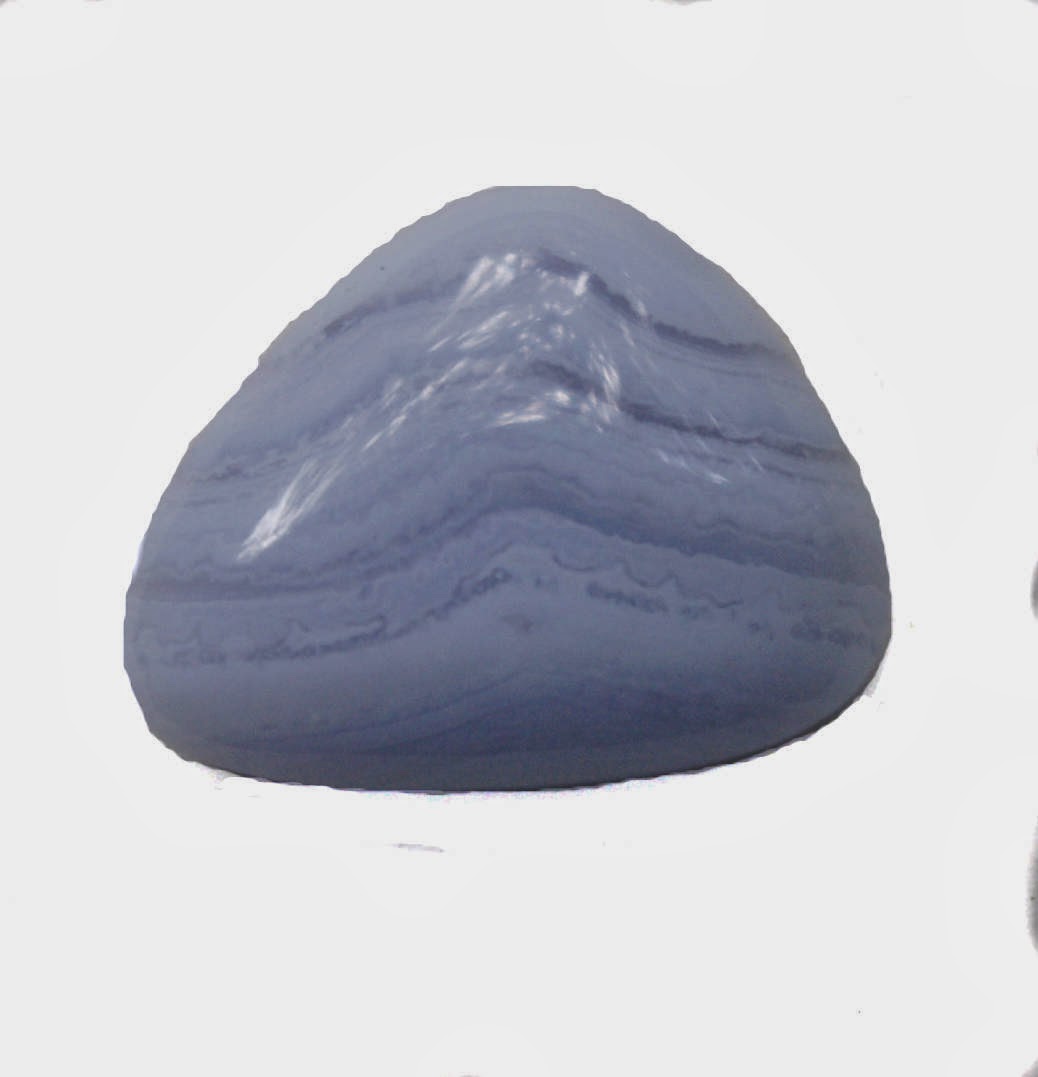
 Blue Lace Agate
 Translucency of Blue Lace Agate
 Dyed blue agate slice with druzy

Plume agate-photo courtesy of Stones That Rock

Agates are formed when gas bubbles that are trapped in solidifying lava become filled with alkali and silica-bearing waters and other mineral impurities, which then gel. The alkali attracts the iron in lava, and the bands of iron hydroxide are created in the gel. Over time, the gel loses water and crystallizes, leaving the bands intact. This is why agate is often found with rings like a tree trunk. It can have tiny quartz crystals, called drusy or druzy, form within that will add sparkle and uniqueness to the stone. Drusy is sometimes cut from the stone and used by itself.
Agates are found all over the world, including Africa, Asia, Brazil, India, Italy, Mexico and the USA. Agates are usually named for the place they are found, but there are different types of banded formations that are added to their name. Listed below are some of the formation types.
Fortification agate- in this type of agate, bands crystallized into concentric layers that basically followed the shape of the cavity it formed in. When sliced, the bands resemble the aerial view of a fort.
Water line agate or onyx- in this agate formation, gravity controlled the formation of the bands. The solution either entered the cavity slowly, allowing for one band to form at a time, or it drained out slowly. The bands in these agates are almost perfectly parallel.
Shadow agate- these agates are formed with alternating translucent and opaque bands. The shadow effect occurs when light moving across the surface causes what appears to be movement across the face of the stone.
Eye agate-this unusual characteristic forms when most of the silica drains from the cavity, leaving behind only droplets that bead up on the inner wall of the cavity. Sometimes crystal growth will continue from this drop similar to the formation of stalactites in caves. Later, the cavity fills in with the usual deposits of chalcedony micro crystals.
Plume agate- these agates first had formations on the outside layer that formed before the deposit of the chalcedony bands. They are filament growths of mineral inclusions that look like feathers or ferns.
Moss agate-this type of agate has mineral inclusions that look like landscapes, plants or trees. These inclusions usually consist of iron or manganese oxide. Sometimes the inclusions inhibit the chalcedony banding and let the mineral clusters freely grow in the silica gel.
Seam agate- these agates grow in cracks in the host rock, rather than in cavities. The bands form in parallel rows that follow and fill in the crack or the seam.
Somewhat in a class by themselves are Lake Superior agates. These agates are only found in a certain region of the US. Glacial activity spread the agates throughout Minnesota, the Upper Peninsula of Michigan, and extreme Northwestern Wisconsin. They can also be found around the Thunder Bay in
NW Ontario, Canada. Lake Superior agates are known for the rich orange, red and yellow coloring. This comes from the iron that is leached from rocks formed millions of years ago from iron rich lava.
Agates are said to be very powerful gemstones. The healing and metaphysical properties are as varied as the colors of the agates themselves.
Bamboo Agate-



Plume agate-photo courtesy of Stones That Rock

Saturday, September 28, 2013
Morganite is the featured gemstone
The lovely pink gemstone, Morganite, is in the beryl family, which
makes it a cousin to emeralds and aquamarines. Discovered in 1910, on
an island off the coast of Madagascar, Morganite was named for
legendary financier and gem collector, J.P. Morgan, after being
called simply pink beryl for the first year or so it was around.
Morganite is the official name of this beryl, but there has been some
attempt in the jewelry trade to change the name to pink emerald, to
make it sound more valuable. Morganite can also be found in colors
from peachy pink, violet pink or a light lilac, and a light salmon
color.
On the Moh scale, Morganite has a good hardness of 7.5 to 8. Unlike emeralds, which often have inclusions, Morganite is usually quite clean and clear. Heat treating is the most common way to bring out the pink in this gemstone. It also removes any yellow shading that might be in the stone.
Most Morganite today, comes from Pala, California, but is also found in Afghanistan, Brazil, Madagascar, Mozambique, Namibia, and Zimbabwe. It is also found in Maine, in the U.S.. In October of 1989, the Rose of Maine, was found at the Buckfield Quarry in Buckfield, Maine. This stone was somewhat orange in hue, and measured 9 inches (23 cm.) long, and about 12 inches (30 cm.) across.
Along with the matrix, it weighed just over 50 lbs. (23 kg.).
Morganite is valued first and foremost for the intensity and saturation of color, followed by size and clarity. The beautiful rosy hues are most often found in larger stones. Pink is the most popular color for jewelry, but the unheated peach and salmon stones have found popularity among collectors. Rare, magenta colored Morganite from the original deposit in Madagascar is still considered to be the finest and the rarest variety of this gemstone.
It is believed that Morganite can foster love, tolerance and empathy, acceptance, and a live and let live attitude.
The Rose of Maine.
 If you want to see more of this beautiful gemstone, just go to google images and put morganite in. You will find some gorgeous rough and polished samples.
On the Moh scale, Morganite has a good hardness of 7.5 to 8. Unlike emeralds, which often have inclusions, Morganite is usually quite clean and clear. Heat treating is the most common way to bring out the pink in this gemstone. It also removes any yellow shading that might be in the stone.
Most Morganite today, comes from Pala, California, but is also found in Afghanistan, Brazil, Madagascar, Mozambique, Namibia, and Zimbabwe. It is also found in Maine, in the U.S.. In October of 1989, the Rose of Maine, was found at the Buckfield Quarry in Buckfield, Maine. This stone was somewhat orange in hue, and measured 9 inches (23 cm.) long, and about 12 inches (30 cm.) across.
Along with the matrix, it weighed just over 50 lbs. (23 kg.).
Morganite is valued first and foremost for the intensity and saturation of color, followed by size and clarity. The beautiful rosy hues are most often found in larger stones. Pink is the most popular color for jewelry, but the unheated peach and salmon stones have found popularity among collectors. Rare, magenta colored Morganite from the original deposit in Madagascar is still considered to be the finest and the rarest variety of this gemstone.
It is believed that Morganite can foster love, tolerance and empathy, acceptance, and a live and let live attitude.
The Rose of Maine.

Tuesday, September 17, 2013
Tanzanite is the featured gemstone
This beautiful blue lavender gemstone is relatively new on the
gemstone market. It was discovered in 1967 by a tailor who was
looking for rubies and was led to a deposit of blue stones, in the
foothills of Mt. Kilimanjaro, by a group of Masai tribesman. It was
first called Blue Zoisite, because it is a type of zoisite, but was
later renamed Tanzanite by Tiffany a&Co. who wanted to capitalize
on the rarity of the stone which is only found in Tanzania. Several
claims were filed, which led to many mines being opened. In 1971, the
Tanzanian government took control of the mines, and in 1976 turned
the running of the mines over to the State Mining Corporation. Their
methods caused production to drop. Tiffany stopped promoting and
buying the stone in the late 70's due to the unreliability of the
supply. By the late 80's, the government had lost control of the area
and it was flooded with thousands of illegal miners. By 1991, the
government had regained control of the area and began issuing
licenses to private domestic parties, which has helped increase and
stabilize the supply. However, when these mines are played out, the
only Tanzanite available will be what is already on the market.
Expert geologists maintain that the odds of Tanzanite being found
anywhere else are one in a million.
The most prized color for Tanzanite is either the sapphire blue or the very intense violet blue. Most Tanzanite mined today is a brownish color, which is heat treated to bring out the deep blues and purples in the stones. Since heat treatment has no effect on the price, it is assumed that finished gems (cut and polished) are heat treated. Any treatment should be disclosed by the seller. On the Moh scale, it has a hardness of 6.5.
There are several gemstones that are confused with tanzanite, among those are iolite, blue spinel, and lower quality blue sapphire. There is a lab created tanzanite called Tanzanique. It does not display the same light defraction as natural tanzanite.
In October, 2002, the American Gem Trade Association, added Tanzanite as a birthstone for the month of December, along with Turquoise and Blue Zircon.
It is believed that Tanzanite can be used to enhance psychic abilities, composure, harmony and poise. It is also said to be beneficial for lowering stress levels and blood pressure and in getting people to slow down and take it easy. It is sometimes called the workaholics stone.
These are a couple of the tanzanite stones I have.

The most prized color for Tanzanite is either the sapphire blue or the very intense violet blue. Most Tanzanite mined today is a brownish color, which is heat treated to bring out the deep blues and purples in the stones. Since heat treatment has no effect on the price, it is assumed that finished gems (cut and polished) are heat treated. Any treatment should be disclosed by the seller. On the Moh scale, it has a hardness of 6.5.
There are several gemstones that are confused with tanzanite, among those are iolite, blue spinel, and lower quality blue sapphire. There is a lab created tanzanite called Tanzanique. It does not display the same light defraction as natural tanzanite.
In October, 2002, the American Gem Trade Association, added Tanzanite as a birthstone for the month of December, along with Turquoise and Blue Zircon.
It is believed that Tanzanite can be used to enhance psychic abilities, composure, harmony and poise. It is also said to be beneficial for lowering stress levels and blood pressure and in getting people to slow down and take it easy. It is sometimes called the workaholics stone.
These are a couple of the tanzanite stones I have.

Friday, August 24, 2012
Herkimer Diamonds are the Featured Stone
Herkimer diamonds are rare double-terminated quartz crystals found in Herkimer, New York. They were discovered in the late 18th century by workman cutting into dolostone outcroppings in the Mohawk River Valley. More were discovered in Herkimer County and because of the clarity and beauty of the stones, they were named Herkimer Diamonds. They have 18 natural facets (6 sides) and two terminations (points).
The bedrock the crystals are formed in began forming billions of years ago in a shallow part of the Cambrian Sea that lapped against the southern part of what is now the Adirondack Mountains. The clarity of this quartz variety from other clear quartzes is a different ratio of carbon to silicon. Geologists think that Herkimer Diamonds formed very slowly in small cavities called vugs. They can also be found in larger cavities called pockets. They can be found clear, smokey or cloudy and can contain a variety of impurities. These impurities can include clusters, scepters, fluid inclusions, phantom and bridge crystals. A fluid inclusion contains a water pocket, plus methane or oil and sometimes even a rare crystal within the crystal. A phantom crystal contains an image of itself within.
Other places produce double-terminated clear crystals and sometimes they are sold as Herkimer Diamonds, but the only stones that can be truly called Herkimer Diamonds are the ones from Herkimer, New York. As with any other gemstone purchase, ask the seller any questions you may have about your purchase. They should be able to knowledgeably answer or be able to quickly find the answer.
It is believed that Herkimer Diamonds are very powerful stones. They are said to promote smooth energy flow, enhance creativity, dream recall, imagination and psychic abilities. They are considered to be energizing and enlivening. It is also believed that they help connect the astral plane with the Earth plane.

Tuesday, June 5, 2012
Agatized Fossil Coral
Agatized fossil coral is a very ancient coral that has gradually turned into agate. This occurred when the silica in the salty ocean water hardened and replaced the limy coral. The coral skeletons appear as tiny flowers on the stone. their appearance may vary greatly in a single stone depending on weathering, oxidation and the original mineral content. The oldest fossil corals are from the Ordovican period, over 450 million years ago. Corals are marine animals with a sac like body, mouth tentacles and skeleton. It is the skeleton that is seen in the fossil. Some people theroize that agatized fossil coral was the inspiration for millefiori (thousand flowers) glasswork.
Fossil coral typically comes in gray, black, brown, yellow, white, and on rare occasions, red colors. the most detailed specimans of fossil coral come from Indonesia. Entire coral heads are often preserved and appear just as they did 20 million years ago. In 2008, Indonesian fossil coral, processed in China to a red color, began appearing in the market place. The process is similar to the one used to make agate a red carnelian color. Fossil coral can also be dyed red, but the color fades over time. Florida and Georgia, in the United States are also a good source of fossil coral. In fact, in 1979, Florida designated it as the state stone. Since it has become agatized, on the Moh scale, fossil coral has a hardness of 7 which makes it suitable for all kinds of jewelry.
 Agatized fossil coral has been worn by people for centuries. It is believed that is can bring luck into a home when used as an ornament, to help with trauma and emotional issues, and is used in ancient healing traditions for women's health problems. Fossil coral was used by sailors as a talisman to ward off bad weather and it was also believed that it could ward off the evil eye.
Fossil coral typically comes in gray, black, brown, yellow, white, and on rare occasions, red colors. the most detailed specimans of fossil coral come from Indonesia. Entire coral heads are often preserved and appear just as they did 20 million years ago. In 2008, Indonesian fossil coral, processed in China to a red color, began appearing in the market place. The process is similar to the one used to make agate a red carnelian color. Fossil coral can also be dyed red, but the color fades over time. Florida and Georgia, in the United States are also a good source of fossil coral. In fact, in 1979, Florida designated it as the state stone. Since it has become agatized, on the Moh scale, fossil coral has a hardness of 7 which makes it suitable for all kinds of jewelry.

Friday, April 27, 2012
Hemimorphite is the Featured Gemstone
Hemimorphite is a lovely blue gem named for the half formed way (hemi) its crystals form. The "faces" that grow on one end differ in the angle and position of the "faces" on the other end. It can grow in two forms. One form is a glassy bladed crystal, while the other form resembles a bunch of grapes, known as botryoidal. It is a zinc silicate stone.
Hemimorphite is a fairly soft stone. On the Moh scale it is a 4.5 to 5. Colors can range from white to a bluish green, with blue being the most common. Temperature change can cause this stone to become pyroelectric and it will give you a small shock when picking it up.
Hemimorphite is found in many locations. Areas along the Belgian-German border, Poland, Pennsylvania, Missouri, Elkhorn, Montana, Leadville, Colorado, and the Organ Mountains in New Mexico. It is also found in several areas of Mexico,England and Zambia. It is mined from the upper parts of zinc and lead ores.


Hemimorphite is a fairly soft stone. On the Moh scale it is a 4.5 to 5. Colors can range from white to a bluish green, with blue being the most common. Temperature change can cause this stone to become pyroelectric and it will give you a small shock when picking it up.
Hemimorphite is found in many locations. Areas along the Belgian-German border, Poland, Pennsylvania, Missouri, Elkhorn, Montana, Leadville, Colorado, and the Organ Mountains in New Mexico. It is also found in several areas of Mexico,England and Zambia. It is mined from the upper parts of zinc and lead ores.
It is believed that hemimorphite can boost self esteem, bring luck and help to increase a perceptive mind. It is associated with the heart chakra and with healing ulcers, blood diseases and cellular disorders. It is also thought that hemimorphite fosters enthusiasm, optimism and high energy.
Some hemimorphite I have.


Wednesday, March 28, 2012
Onyx is the Gemstone of the Week
Onyx is a form of chalcedony quartz mined in Brazil, India, California and Uruguay. Black onyx is the most common form of the stone on the market today. Onyx is most often a solid color, although there is white banded onyx called sardonyx. Onyx comes in many colors, but the most popular is black onyx. The use of onyx as carvings and jewelry goes back to the second dynasty of Egypt and it is mentioned in the Bible, and was known and used in ancient Rome and Greece. It has been commonly used in cameos. It is also used to create marble tile used in houses today. The quartz in the onyx gives the marble tiles a bit of extra durability.
The large majority of black onyx on the market today has been heat treated or dyed to enhance the color. On the Moh scale, Onyx is a 7. The name comes from the Greek work "onyx" which means claw or fingernail.
According to legend, onyx came into being one day when Venus was asleep, Cupid cut her fingernails and left the clippings laying on the ground. Since no part of a heavenly body can die, the gods turned the clippings into stone which became known as onyx.
It is believed that onyx can help change habits, aid with insomnia, and eliminate negative thinking. It is also believed to eliminate stress and apathy. It is also said that onyx increases happiness and intuition. It is said that onyx can help with objective thinking and spiritual inspiration.
 Green Onyx
Sardonyx

Tuesday, March 6, 2012
Amber is the Gemstone of the Week
Even though Amber is considered to be a gemstone, it is really fossilized tree resin that has been appreciated for it's natural beauty and color for thousands of years. Amber deposits have been found that range in age from 360 and one million years old. As resin oozed from now extinct conifer trees and pine trees, bits of plant life, insects and other small objects became trapped in it. As time passed, the resin became encased in dirt and debris and eventually fossilized. In order to be called Amber, the resin must be several millions years old. Recently hardened resins are called copals. Amber is perhaps one of the oldest gemstones used for human adornment. It has been found in European grave sites dating back to 8000 B.C..
Heating Amber will cause it to soften and eventually burn. if heated over 200 C, it decomposes, leaving behind a black residue known as "amber colophony" or "amber pitch", which, when dissolved in turpentine or linseed oil forms "amber varnish" or "amber lac".
Amber is found in many different colors. Besides the usual yellow-orange-brown that is commonly associated with the name Amber, it is also found in red, also called cherry amber, green amber and even blue amber, which is rare and highly sought after. The most highly prized Amber is transparent. Opaque Amber contains many tiny bubbles and is referred to as honey amber. Although all Dominican Amber is florescent, the rarest Dominican Amber is blue amber. It turns blue in natural sunlight or any other whole or partial ultraviolet light source. Only about 100kg a year are found which is the main reason it is so valued. Amber is a soft gemstone, on the Moh scale it is a 2 1/2-3 and care must be taken when wearing it to avoid scratching or chipping it. Quite a bit of the Amber found in jewelry today is reconstituted which makes a stronger stone. It is made by combining small bits of Amber with linseed oil, and compressing it. One way to tell if a stone is reconstituted is to look at the bubbles in it. Reconstituted stones have elongated bubbles, while natural stones have spherical bubbles. Sometimes the reconstituted Amber is called ambroid.
Gem quality Amber is most often from the Baltic Sea area. About 90% of the world's Amber supply comes from here. Baltic Sea Amber has a high market value. Amber is also found in the Dominican Republic, Russia, Myanmar (Burma), Germany, Romania, Sicily, and Malaysia.
Amber is said to bring wisdom, purification, energy and balance. It is believed to enhance calmness, patience, strength and healing. It is also believed that Amber draws negative energy out of the body and purifies the heart and spirit.

Blue Amber
Thursday, February 9, 2012
Larimar is the Gemstone this Week
As far as gemstones go, Larimar is a relative newcomer to the scene and still not widely used. It was first discovered in 1916 by Father Miguel Domingo Fuertes Loren, but when he filed for a mining claim, it was rejected. Legend has it that it was then forgotten. In 1974, a Peace Corps volunteer, Norman Rilling and a Dominican Republic native, Miguel Menendez, found some Larimar on the beach. The locals had long believed that Larimar came from the sea and gave it the name Blue Stone. The stones found on the beach were alluvial sediment which had been washed into the sea by the Bahoruco River. The tumbling action of the water polished the stones so the beautiful blue showed and made the easily distinguishable from the river rocks. An upstream search revealed the source and soon, the Los Chupaderos mine was formed. The name comes from a combination of Larissa, "Lar", which is the name of Menendez's daughter and "mar" which is Spanish for sea.
Larimar is a variety of pectolite, an acid silicate hydrate of calcium and sodium. Pectolite is found around the world, but none have the distinct volcanic blue that Larimar has. Pectolite is usually a soft, delicate mineral composed of dense, radiating fibers, but sometimes the fibers are tough and interlock to form a much stronger stone. The blue color is the result of cobalt substitution for calcium and coppper. It is rarely a solid blue, but has white interconnecting lines and sometimes rough circles. Larimar is only found in the Dominican Republic. The more intense the blue and the contrasts in the stone, the more valuable it is. Larimar is photosensitive and the blue will fade if exposed to strong sunlight for a long period of time.
Larimar is not treated or enhanced, but sometimes white gemstones are dyed to look like Larimar.
On the Moh scale, it has a hardness of between 5-7, with the darker blue stones being closer to 7.
It is believed that Larimar can help view events from different perspectives, and can heal the emotional, physical, mental and spiritual body. It is also said to be helpful for those with stress and anxiety. Larimar is said to represent peace and clarity, healing and love.
These are photos of some earrings I made for myself using some Larimar 10mm beads and some facted Aquamarine. The stones were a gift from a wonderful friend who was clearing out someof her stash. Thanks, Margaret, of Bohowirewrapped .


Tuesday, January 10, 2012
Garnet is the Gemstone of the Week
Garnet is the birthstone for January and the gemstone of the week. Garnet comes in many hues, except for blue, and most varieties are named for their color. The deep maroon color is the color associated with January and is called Almandine garnet. Garnets are one of the largest families of gemstones and the coloring depends on the minerals in the stone. It is a popular gemstone and is suitable for all types of jewelry since it has a hardness of 7.5 on the Moh scale.
The word "garnet" comes from the Latin word "granatum" which refers to the pomegranate and the color red. The use of Garnet as beads and in inlay work goes back as far as 3100 B.C. and 2300 B.C. in Egypt. Garnets have been found entombed with Egyptian pharaohs as a prized possession for the after life. Red Garnets have been prized by nobility across the ages. With the discovery of the famous Garnet mines in Bohemia, Czechoslovakia in 1500 A.D., Bohemia became a center for jewelry manufacturing and gem cutting. This increased the demand for the gem in Europe and increased the price. The popularity of this gemstone started to fade in the 1800's.
Enhancements are usually heat treatments or irradiation. Some garnets are dyed. When you are shopping for garnets, remember, all treatments must be disclosed.
Friday, December 23, 2011
Merry Christmas and Happy New Year
Thank you for reading and following my blog. I have learned a lot writing the gemstone blog posts and I hope you have enjoyed reading them and maybe gotten some useful information from them.
I'm going to resume the gemstone blog posts after the first of the year. I'm taking a little holiday break. I want to wish you all a Merry Christmas, or if you celebrate a different holiday, a Happy Holiday Season. Please celebrate safely. May the new year bring you peace and happiness.
Sue
I'm going to resume the gemstone blog posts after the first of the year. I'm taking a little holiday break. I want to wish you all a Merry Christmas, or if you celebrate a different holiday, a Happy Holiday Season. Please celebrate safely. May the new year bring you peace and happiness.
Sue
Sunday, December 11, 2011
Zircon is the Gemstone of the Week
Zircon is considered to be one of the birthstones for those born in December. Although this stone has been known since the Middle Ages, the oldest known Zircons, from Western Australia are 4.4 billion years old. There are several theories as to where the name comes from, but the most common one is that it comes from Persian word "zargun" which means gold colored, even though Zircons come in several different colors. Clear or colorless Zircons can rival diamonds for sparkle and shine. They are often considered to be a cheap substitute for diamonds, but can often be a valuable gemstone.
Zircons are a dense gemstone which means that the carat size of this gemstone will look smaller than the same carat size of a different gem. It is a remarkable mineral in that it can be found in many different types of rock. It is one of the most widely occurring minerals and can be found throughout the world. On the Moh scale, it has a hardness of 7.5, so it is a fairly strong gemstone.
Natural Zircon comes out of the Earth in brown, yellow, green and bright red. Some of the trace elements that give the stones their color can sometimes be radioactive. These stones are heat treated and that can produce the much desired blue color, along with white, purple, colorless, orange an pink. Heat treating is the most commonly used enhancement for Zircons. It is done to stabilize the stones and for coloring. Heat treating semi transparent grayish brown and reddish brown stones in an oxygen free environment will give it a blue color. If the same stones are then heat treated with air, the color will turn golden brown. Almost all colorless and blue Zircons are heat treated.
Zircon occurs in beach sand in many parts of the world, especially in Australia, India and Brazil. Thailand, Cambodia and Viet Nam are major sources of Zircon. It can also be found abundantly in Sri Lanka, and Myanmar. It is also found in Quebec, Tanzania, Mozambique, Nigeria, Pakistan, Afghanistan, and Madagascar.
It is believed that Zircon helps one be more at peace with oneself, bring honor and and wisdom and to aid in peaceful sleep. It is also thought to promote inner renewal, foster independence, spirituality and friendliness, and bring inspiration.
Hindu poets wrote of the Kalpa Tree. This ultimate gift to the gods was a gemstone tree with leaves of green Zircon.
Natural Zircon
Photo courtesy of R.Weller/Cochise College

Blue Cambodian Zircon
Monday, November 28, 2011
Topaz is the Gemstone of the Week
Topaz is a gem of many colors, although the name is primarily associated with the color yellow. The gold or yellow topaz is considered to be a birthstone for November and the blue variety is considered to be the birthstone for December. Pure Topaz is colorless, with the other colors being created from impurities/minerals in the stone or enhancement of some type. The variety of colors, the strength, and a relatively good supply make Topaz a very popular gemstone. The name Topaz is believed to come from the Sanskrit word "tapas" which means fire.
Topaz is often found with flourite and cassiterite in various mountain areas including the Urals, in Russia, Afghanistan, Pakistan, Sri Lanka, the Czech Republic, Germany, Norway, Italy, Brazil, and Sweden. Some clear Topaz crystals from Brazil, which is the largest producer of Topaz, can reach boulder size and weigh hundreds of pounds. A Topaz called the American Golden Topaz weighs in at 22,892.5 carats.
Topaz is often called by many different trade names for the different color varieties. Some of those are Azotic Topaz, an orange pink stone with a rainbow color effect. It is synthetically colored by a thin film deposition of a thin metallic layer over the gemstone. It is named for the company that created this kind of finish-Azotic. London Blue Topaz is a deep sky blue color. It is darker than Swiss Blue Topaz. Mystic Topaz has a rainbow finish very similar to Azotic Topaz. Sherry Topaz has a light orange brown to brownish pink color. Silver Topaz or White Topaz are both trade names for the clear variety of Topaz.
Citrine can resemble Topaz and sadly, there are unscrupulous dealers who sell the less expensive Citrine as Topaz. Some of the names this false Topaz is sold under are Bahia Topaz, Citrine Topaz, Gold Topaz, Maderia Topaz, Spanish Topaz and Topaz Quartz. Smokey Topaz is really Smokey Quartz, and Indian Topaz, King Topaz and Oriental Topaz are really orange yellow Sapphires. As with any gemstone purchase, do your research and find a reputable dealer to buy from.
It is believed that Topaz balances emotions, calms passions and releases tensions. It is also believed to inspire leadership abilities and spiritual growth.
This is the American Golden Topaz which is on display in the Smithsonian. On the left is the Lindsay Uncut Topaz which weighs 70 pounds. On the right is the Freeman Uncut Topaz which weighs 111 pounds. They are also in the Smithsonian.

.
Sunday, November 13, 2011
Citrine is the Gemstone of the Week
Citrine, a beautiful gemstone ranging in shade from yellow to gold to orange is one of the birthstones of November. A member of the quartz family, the name comes from the Latin word "citrina" which means lemon. The color comes from the presence of iron.
Natural Citrine, which is a pale yellow color, is not common. It is sometimes marketed as Lemon Quartz. Most of the Citrine on the market today is heat treated Amethyst or Smokey Quartz. The color can be changed by heating to a relatively low temperature-around 750 degrees Farenheit and the darker colors can be achieved by heating to around 1700 degrees Farenheit. Almost all heat treated Citrine has a reddish tint to it.
Brazil is the main source of Citrine, with other deposits being found in Argentina, Madagascar, Zaire, Namibia, Spain and Russia. On the Moh scale, it has a hardness of 7. Flawless stones of many carats are not uncommon with the gemstone.
Citrine's sunny color has given it the reputation of being a gemstone that radiates positive energy and one that dissipates negative energy. It is also known as the "success stone" because it is believed to promote success, prosperity and abundance, especially in business. It is also believed that Citrine will relieve depression, self doubt and anger and can reduce self destructive tendencies. It is also believed that Citrine can aid in sleep disturbances, digestive and thyroid problems, and strengthen the immune system. Citrine is also believed to be valuable in healing the spiritual self and to enhance the enjoyment one gets from life.
 This is a picture of the largest cut Citrine in the world. It weighs in at a whopping 20,200 carats. Itis on display in Malaga, Spain in a special exhibition of rare gemstones.
Natural Citrine, which is a pale yellow color, is not common. It is sometimes marketed as Lemon Quartz. Most of the Citrine on the market today is heat treated Amethyst or Smokey Quartz. The color can be changed by heating to a relatively low temperature-around 750 degrees Farenheit and the darker colors can be achieved by heating to around 1700 degrees Farenheit. Almost all heat treated Citrine has a reddish tint to it.
Brazil is the main source of Citrine, with other deposits being found in Argentina, Madagascar, Zaire, Namibia, Spain and Russia. On the Moh scale, it has a hardness of 7. Flawless stones of many carats are not uncommon with the gemstone.
Citrine is most often confused with orange-yellow topaz which is very similar in color. Topaz is the more valuable stone and sometimes, unscrupulous dealers will pass Citrine off as topaz. Some of the more common trade names for these gems are "Madeira Topaz", "Gold Topaz" and "Bahia Topaz".
Citrine's sunny color has given it the reputation of being a gemstone that radiates positive energy and one that dissipates negative energy. It is also known as the "success stone" because it is believed to promote success, prosperity and abundance, especially in business. It is also believed that Citrine will relieve depression, self doubt and anger and can reduce self destructive tendencies. It is also believed that Citrine can aid in sleep disturbances, digestive and thyroid problems, and strengthen the immune system. Citrine is also believed to be valuable in healing the spiritual self and to enhance the enjoyment one gets from life.

Monday, October 31, 2011
Ametrine is the Gemstone of the Week
The name Ametrine comes from a combination of Amethyst and Citrine, which is exactly what Ametrine is. The color is the result of iron in the quartz. Ametrine colors come in bands of yellow and purple and often show and abrupt color change in the stone. This is the only stone where you can get “two” gemstones for the price of one.
There is only one basic source for Ametrine and that is the Anahi Mine in Bolivia. In the seventeenth century, this mine became famous when a Spanish conquistador received the mine as a wedding gift when he married Princess Anahi of the Ayoreos tribe. He knew the unique gemstones would find favor with the Spanish queen, and introduced Ametrine to Europe. The mine has only been commercially worked since the 1980's.
Being a member of the quartz family, it is a fairly durable gemstone. On the Moh scale, it has a hardness of 7. Ametrine is typically cut to give a 50/50 color split. It is popular among among gemstone cutters and carvers because of the color variations and play in the stone. Despite the fact that there is only one source for this beautiful gemstone, it is reasonably priced.
Ametrine is rarely enhanced, but if it is, it is enhanced by a heat treatment. Natural Ametrine only comes on purple and yellow, so if you see some blue-yellow or geen-yellow combinations being sold, be aware that they are synthetic, lab created stones.
It is believed that Ametrine helps achieve a balance between the spiritual world and the material one, and can enhance cooperation with others. It is alsosaid to help with headaches and backaches. It is also said that the purple part of the stone helps one visualize the future one wants, while the yellow part of the stone helps achieve those goals.
I don' thave any Ametrine to photograph and show you, and I couldn't find any photos to include that wouldn't violate somebody's copyright, so here is a link to page of Google Images for
Thursday, October 13, 2011
Opal is October's birthstone and the Gemstone of the Week
Opal is the featured gemstone this week, because it is also the birthstone for October. Often called nature's fireworks, this gemstone is composed of hydrated silica. Since the structure is not truly crystalline, it is considered a mineraloid, rather than a mineral. Opal has the same chemical composition as quartz, but has a water content between 3% and 21%, although the average water content is between 6% and 10%. Fine examples of opal can be more valuable than diamonds. It is a somewhat soft stone. On the Moh scale, it has a hardness of 5.5-6.5.
The internal structure of opal makes it defract light and, depending on the conditions in which it was formed, the stone can take on many colors. These colors can range from clear, white, gray, yellow, orange, green, blue, magenta, rose, pink, slate, olive brown and black. Red hues against black are the most rare, with white and green being the most common. The iridescent color flashes, are called opalescence, and change depending on the angle from which the stone is viewed.
Most opal is over 60 million years old, which dates it back to the time when dinosaurs roamed the Earth. Opal has been considered a gemstone since Roman times when it was considered to be second in value only to emeralds. The name, “opal” probably comes from “upala”, the Sanskrit word for precious stone.
Opals are usually sold in one of three ways. The solid gemstone by itself, although it is usually enhanced by some type of wax treatment to protect it from drying out. Opal doublets are thin slices of opal glues to a base material such as ironstone, basalt or obsidian. The darker color backing emphasizes the play of colors in the gemstone. Opal triplets are doublets topped with a domed cap of clear quartz, resin or plastic. This protects the relatively soft stone from scratches, while magnifying the play of colors in the stone.
Opals are most commonly from Australia, but are also found in the Czech Republic, Turkey, Indonesia, Brazil, and in the United States, in Nevada. In 2008, NASA also announced that they had found opal deposits on Mars.
Opal is believed to aid in the healing of eye diseases, enhance creativity, and to foster love and warmth. The ancient Romans considered the stone to be one of good fortune, while the Russians considered it to be bad luck. Queen Victoria loved opals and she and her daughters created a fashion trend for opal jewelry.
div style="margin-bottom: 0in;">


The internal structure of opal makes it defract light and, depending on the conditions in which it was formed, the stone can take on many colors. These colors can range from clear, white, gray, yellow, orange, green, blue, magenta, rose, pink, slate, olive brown and black. Red hues against black are the most rare, with white and green being the most common. The iridescent color flashes, are called opalescence, and change depending on the angle from which the stone is viewed.
Most opal is over 60 million years old, which dates it back to the time when dinosaurs roamed the Earth. Opal has been considered a gemstone since Roman times when it was considered to be second in value only to emeralds. The name, “opal” probably comes from “upala”, the Sanskrit word for precious stone.
Opals are usually sold in one of three ways. The solid gemstone by itself, although it is usually enhanced by some type of wax treatment to protect it from drying out. Opal doublets are thin slices of opal glues to a base material such as ironstone, basalt or obsidian. The darker color backing emphasizes the play of colors in the gemstone. Opal triplets are doublets topped with a domed cap of clear quartz, resin or plastic. This protects the relatively soft stone from scratches, while magnifying the play of colors in the stone.
Opals are most commonly from Australia, but are also found in the Czech Republic, Turkey, Indonesia, Brazil, and in the United States, in Nevada. In 2008, NASA also announced that they had found opal deposits on Mars.
Opal is believed to aid in the healing of eye diseases, enhance creativity, and to foster love and warmth. The ancient Romans considered the stone to be one of good fortune, while the Russians considered it to be bad luck. Queen Victoria loved opals and she and her daughters created a fashion trend for opal jewelry.
div style="margin-bottom: 0in;">
Rough opal from a Nevada mine


The Queen's Opal weighs in at 203 carats or 41 grams.
Sunday, October 2, 2011
Chalcedony is the Gemstone of the Week
Chalcedony (cal-see-doh-nee) is the name for a group of stones made of microcrystalline quartz. This just means that the quartz crystals are too small to be seen without high magnification. In the gem trade, chalcedony is usually used to describe the white, gray, light purple, or light blue translucent stones. The light blue and the light purple are the most popular colors. Chalcedony occurs in many different forms, colors and patterns and has been used in jewelry for centuries.
The varieties of Chalcedony are often named based on color. Agates are a multicolored variety of Chalcedony. Carnelian, aventurine and jaspers are also Chalcedony varieties. Chalcedony is well suited for jewelry with a hardness on the Moh scale of 6.5 to 7. It is a porous stone and is often dyed to enhance the color. The name comes from the ancient Greek town of Chalkedon in Asia Minor.
Chalcedony is found in many locations. Turkey is a good source for purple and blue stones, along with several different locations in Africa. There are also active blue and purple mines in the U.S.. It is also found in Brazil, Germany, Russia, Canada and Indonesia.
Because of the abundance and durability of Chalcedony, its usage goes back to as early as the 7th century B.C..The early Mesopotamians used it in seals and that practice was adopted by the Romans. It was also used as projectiles, knives and containers.
It is believed that Chalcedony aids in emotional balance, energy, generosity, charity and friendliness. It is also said to banish fear, depression, and touchiness. It is also thought to aid eyesight, reduce fever and stimulate creativity.
Light Blue Chalcedony


Tuesday, September 6, 2011
Sapphire is the Gemstone of the Week
Sapphire is the birthstone for September and the gemstone of the week. Sapphires are the most precious and valuable of the blue gemstones, although they come in many other colors. Sapphires are made from the mineral corundum, like rubies, and are the second hardest gemstone after diamonds. On the Moh scale, they are a 9. All corundums that aren't rubies, are classified as Sapphires.
Padparascha is a pink orange variety of Sapphire that is very rare and highly valued. The word comes from the Sinhalese word for lotus blossom. Along with rubies, they are the only type of corundum to be given their own name rather than being called a particular color of Sapphire. The original mines are in Sri Lanka, but other deposits are found in Viet Nam and Africa. It is often higher priced than even the finest blue Sapphires. More Sapphires of the color have appeared in the market lately due to a new treatment called “lattice diffusion”.
Fancy color Sapphires are how the green, yellow and pink varieties are often classified. Pink Sapphires deepen in color as the amount of chromium increases. The deeper the pink, the higher the value, as the color then trends towards ruby.
Star Sapphires are stones that exhibit a star like phenomenon known as asterism. This is caused by intersecting needle like inclusions that cause a six rayed star to appear when viewed with an overhead light source. The Black Star of Queensland is believed to be the largest Star Sapphire ever mined, weighing in at a whopping 733 carats. Star Sapphire value not only depends on the size of the stone, but the body color and the intensity and visibility of the star.
Sapphires are treated by several methods to improve the clarity and color. Heat treatment is the most common method. Evidence of heat treating these stones goes back to Roman times. Un-heated stones are very rare and will often be accompanied by a certificate from an independent gem lab stating that there is no evidence of heat treatment.
Diffusion treatments are controversial as they add elements to the stone to improve color. Beryllium is diffused into a stone using very high heat, just below the melting temperature of the stone. Orange Sapphires were originally created with this process, but it now extends to all colors. It is unethical to sell these treated stones without disclosing this treatment fact and the price should be much lower than an untreated or just a heat treated stone. Treating stones with this diffusion method is frowned upon because if the stone chips or is repolished or refaceted, the color layer can be removed. Treated stones are very difficult to detect and it is recommended that you get an certified gemological lab certificate before investing in the stone. The Federal Trade Commission states that any sort of treatment on a stone that significantly affects the value of a stone, must be disclosed.
It is believed that Blue Sapphires inspires creative expression, intuition, and meditation. Green Sapphires are believed to bring luck, Pink Sapphires encourage love, loyalty and generosity,Padparascha sapphires augment wisdom, optimism and friendliness. It is also believed that Star Sapphires develop independence and balance.
A piece of pink Sapphire rough and some pink Sapphire beads that I have.


The Logan Sapphire Brooch


The Black Star of Queensland
Subscribe to:
Posts (Atom)