Showing posts with label DancingWindDesgins. Show all posts

Tuesday, July 5, 2011

Flourite is the Gemstone of the Week

Flourite has been nicknamed “the most colorful mineral in the world.” It comes in a range of sparkling colors from purple, blue, green, yellow, colorless, brown, pink, black to reddish orange. Intermediate pastel colors can be found in between the colors in some stones, also. Some Flourite is a single color, but most have multiple colors arranged in bands. A now scarce variety of purple blue Flourite, known as Blue John, is found in one of the oldest known localities for the gemstone, Castleton, Derbyshire, England. It is still mined there, but only a few tons per year.
Flourite was first called flourspar. Flourite derives from the Latin noun, “fluo” meaning stream or flow. Flourspar comes from the German “flusse” meaning stream and “spaerstan” meaning spear. It is a relatively soft stone, a 4 on the Moh scale. It is composed of calcium flouride.
Flourite is a widely occuring mineral found in large deposits in many areas of the world. Deposits are found in China, Austria, Germany, Switzerland, England, Norway, Mexico, Kenya, and Ontario, Newfoundland, and Labrador, in Canada. In the United States, deposits have been found in Missouri, Oklahoma, Illinois, Kentucky, Colorado, New Mexico, Ohio, New Hampshire, New York, Alaska, and Texas. In 1965, Flourite was named the state mineral of Illinois since at that time, Illinois was the largest Flourite producing state in the U.S.. In 1995, the last Illinois mine was closed.
Besides being used as a gemstone, Flourite also has industrial uses depending on which of the three purity grades it is. Metallurgical grade Flourite, the lowest grade has been used a flux to lower the melting point of raw materials used in steel production. Ceramic 
grade, the middle level of purity, is used in making opalescent glass, enamels and cookware. The highest grade, which is 97% pure, is acid grade Flourite which is used to make hydorgen flouride and hydorflouric acid by decomposing the Flourite with sulfuric acid. There is also synthetically grown Flourite which is used instead of glass in some high grade telescopes and camera elements.
When it come to the metaphysical aspect of Flourite, it is believed that Flourite opens pathways of the brain to higher dimensions of light, increases alertness and mental activity and helps in grasping complex and abstract concepts. It is also thought to bring in objectivity and concise thoughts, action and behavior.

These photos show some of the different colors, and the banding of Flourite.


Wednesday, June 8, 2011

Moonstone is the Gemstone of the Week

Moonstone, the gemstone of the week, is also the European birthstone for June.  This mysterious beauty has been used for jewelry since before AD 100. The ancient Romans believed that is was created from the solidified rays of the Moon. It is considered to be the second birthstone for the month of June. During the Art Nouveau period, this was a very popular gemstone. Famous jewelry houses such as Cartier's and Tiffnay used it in a lot of their pieces.
Moonstone is a member of the feldspar family, and is a potassium aluminum silicate. It is an opalescent stone and, like Labradorite, has flashes of color called schiller. In Moonstone, schiller is more often called adularescence-a billowy, floating color effect. It comes from the word “adularia” which was the first name for this gemstone. It was called after the first place moonstone was found, Mt. Adular, in Switzerland. Adularescence is created when light falls between two layers of feldspar that have intermixed, causing the light to scatter, producing the schiller effect.
On the Moh scale, Moonstone is a 6-6.5. The colors can range from blue, peach, green, pink, yellow, brown or gray, all with a silvery sheen. Rainbow Moonstone is a milky white with a rainbow sheen. The most valuable moonstone is one that has a colorless, transparent to semi-transparent appearance with a vivid blue adularescence. Ideally, the sheen should be centered to the top of the gemstone. Moonstone is found in Brazil, Madagascar, Europe, Myanmar, Tanzania, and in the U.S. in Pennsylvania and Virgina. The highest quality gemstones come from Sri Lanka. They are most often cut in cabochons to best display their adularescence.
Moonstone is believed to refresh memory, soothe and balance emotions and act as a digestive aid. It is also believed to heal strife between lovers and awaken passion.

Here are some of the moonstones I have.
Rainbow briolettes, rainbow faceted beads, peach, rainbow, white and gray and faceted peach beads.


Thursday, June 2, 2011

Pearls are the Gemstone of the Week

 
The birthstone for June, Pearl, is the gemstone of the week. This precious gemstone has been used in jewelry and ornamentation for centuries.
Most gemstones are minerals, but Pearls are organic and formed by living organisms. They are formed in the soft tissue layers of mollusks, such as oysters and mussels and begin forming when an irritant such as sand, gets inside the shell. They are made of calcium carbonate and organic conchiolin, that build up as concentric layers . (If you cut a pearl in half, the inside layers would resemble tree rings.)This is done in order to protect the inside of the oyster or mollusk from the irratant. This process can take anywhere from 4 months to 7 years. The longer it takes, the larger the pearl.


There are two basic kinds of Pearls-natural and cultured. Natural pearls occur in nature without assistance from humans and are very rare and because of the rarity, they are very expensive. Cultured pearls are created when humans insert the irritant into the shell. Cultured pearls are grown on pearl farms where they are cared for while the pearl grows. Some pearls are started from an irritant type of nucleus, some, like the Akoya pearl, are formed around a bead nucleus. Only one out of four cultivated mollusks lives to grow a marketable pearl. Since natural pearls are so rare, it is safe to assume that most pearls on the market today are cultured. Pearls are among the softest gemstones on the market. On the Moh scale, they are only 2.5.
The most valuable pearls are perfectly symmetrical, fairly large and naturally produced. They have a shimmering iridescence which is called orient. I've listed a few of the more common terms used for 
pearls. Baroque pearls have an irregular shape. Biwa pearls are from the freshwater lake, Lake Biwa, in Japan and also have an irregular shape. Blister pearls grow attached to the inside of the shell. Freshwater pearls grow in freshwater mollusk and resemble puffed rice. Mabe pearls are cultivated blister pearls. Oriental pearl is another name for saltwater pearl.
Pearls are often enhanced by dyeing. They are very porous and accept dye well. It is the easiest, and least expensive way to get a matched strand. One drawback to this is that the dye can fade over time. They can also be bleached to increase their whiteness. Irradiation darkens the nucleus of the pearl to produce darker pearls like blue gray and black. Most experts believe this to be permanent. Metallic pearl colors are often both dyed and irradiated. As a general rule, all bright or striking pearl colors are dyed or enhanced in some way.
Pearls are found in Japan, China, Tahiti, Ceylon, Scotland, Norway, Australia, Indonesia, the Gulf of Mexico, and Myanmar. The finest Oriental Pearls are found in the Persian Gulf.
It is believed that Pearls help people see themselves, and eliminate emotional imbalances. They are also thought to give wisdom through experience. Ancient Chinese myths told of pearls falling from the sky when dragons thought. The ancient Greeks thought that pearls were the tears of the gods.

These photos are some of the Pearls I have in my gemstone stash.

 Faceted Pearls
 Keishi Pearls
Pale Pink Pearls

Friday, May 20, 2011

Sodalite is the Gemstone of the Week

Sodalite,an opaque, royal blue gemstone with white streaks, is often confused with Lapis Lazuli. It is one of the minerals that makes up Lapis. The chemical compostion of Sodalite is sodium aluminum silicate chloride. The chloride is what differentiates this from Lapis. Lapis contains sulphur. There are two ideas for where the name comes from-one is for the sodium content and the other is from the Latin word “solidus” for solid, since it was a solid used in the process of glass making. It will fuse to a colorless glass if heated to a high enough temperature.
Sodalite is a hard mineral, yet because of the crystal structure, fragile with a hardness on the Moh scale of 5-5.6.
Sodalite is sometimes referred to as Princess Blue after Princess Patricia, granddaughter of Queen Victoria. She fell in love with this gemstone after a visit to Ontario, Canada and used it to decorate Marlbourough House in England. Sodalite has been discovered in ancient ruins and tombs in ornamental forms. It was often used as a substitute for Lapis Lazuli.
Signifiacant deposits of Sodalite are found in Bancroft, Ontario, Mont-St-Hilaire, Quebec, Lichtfield, Maine, and magnet Cove, Arkansas. Smaller deposits are found in Brazil, Bolivia, Portugal, Romania, Burma, and Russia.
It is believed that Sodalite was used by Egyptian priests to dispel fear and promote a clear insightful mind. It is also believe to help with a wide range of physical aliments from diabetes, and digestion issues to thyroid problems. It is also thought to be a soothing stone and to instill confidence.

Monday, May 9, 2011

This week Serpentine is the Gemstone of the Week

Serpentine is the name given to a large variety of rock forming minerals that are green, yellowish green, or brownish green in color. There are over twenty varieties of Serpentine and they are not always easy to tell apart. All Serpentines are a basic magnesium silicate. The name comes from the Latin “serpentinus” meaning snake rock. The mottled colors do give it the appearance of snakeskine. In mineralogy and gemology, Serpentine is divided into three groups, antigorite, chrysotile and lizardite.


Serpentine ranges from opaque to translucent and the Moh scale hardness varies within the different varieties. On the Moh scale hardness ranges from 2.5 to 5.5. Antigorite is the hardest variety. Serpentine is often streaked with the minerals calcite and dolomite. These minerals are what give Serpentine the white and gray streaks.


Several trade names have been given to Serpentine to distinguish the different varieties. These are bowenite, connemara,verde-antique and williamsite. It is often sold under the names of new jade, lemon jade, olive jade, Afghan jade and green jade. When buying, this is something you need to be aware of as these stones are not jade at all, but Serpentine.
Serpentine is found in many places around the world, including Afghanistan, Burma, China, New Zealand, Canada, the United Kingdom, Greece, Italy, Norway, and the U.S.. In the U.S. it is found in Northern California, Rhode Island, Conneticut, Mass., Maryland and southern Pennsylvania.
It is said that Serpentine can restore self confidence, repel fear, and enhance meditation. It is also believed to bring good luck and to help people obtain their dreams.
This Serpentine piece is in a necklace I made. It is a yellowish green, almost chartreuese color.

Sunday, May 1, 2011

Emeralds are the Gemstone of the Week

This week, the gemstone of the week is also the birthstone for May, the beautiful, enchanting, lush green Emerald. The name comes from the French word “esmaraude” which in turn, goes back via Latin to the Greek root “smaragdos” which simply means “green gemstone”.


Emerald is the most precious and expensive member of the Beryl family of gemstones. It is classified as one of the four traditional gemstones along with diamonds, sapphires and rubies. Along with being the birthstone for May, it is the gemstone for the 20th and 35th anniversary.

Clarity is important for Emeralds, but inclusions or flaws, are much more tolerated with this stone than they are with other gems. They help assure the buyer that they are getting a genuine Emerald. This gem has a hardness on the Moh scale of 7.5-8. Inclusions do make this stone brittle and more difficult to cut. Because of the enhancements to Emeralds, which I will cover a couple of paragraphs down, these stones should not be cleaned using ultrasonic jewelry cleaners.


Color is the main consideration when grading and pricing Emeralds. By definition, Emerald is a medium or darker green to bluish green. The most valuable stone is slightly bluish green with a medium dark tone with strong to vivid color saturation. Emerald color comes from chromium, vanadium or a combination of both. Emerald is a beryllium aluminum silicate.


Emeralds are often enhanced by oiling.This is done by placing the stone in a vacuum chamber with heated oil, and sometimes resins. Not only does this improve the appearance of the stone, but also helps to fill in the inclusions it has. Steam cleaning, using solvents or ultrasonic jewelry cleaners will remove these oils and change the appearance of the stone. Clean an Emerald with a soft, dry cloth.

Almost all Emerald mining is done from host rocks where the Emerald has grown into small veins or on the walls of cavaties. Columbia is the world center for Emerald mining. Northwest of Bogota is a mine called the Muzo mine which produces deep green, fine quality stones. To the Northeast of Bogota is the mine called Chivor which also has high quality deposits of Emeralds. Brazil also has Emerald mines which produce a lighter color green gem. There is also a mine in Brazil which produces a rare form of Emerald known as a Trapiche Emerald. This stone is characterized by star shaped rays that come from the center of the stone in a hexagonal pattern. This pattern is caused by black carbon impurities that form in a star pattern. Emeralds are also found in Transvaal, Zimbabwe, Russia, Australia, Ghana, India, Madagascar, Malawi, Mozambique, Namibia, Nigeria, Pakistan, Tanzania, and Zambia. Not all of these deposits produce high quality stones, some are suitable only for beads and cabachons. They are also found in the U.S. in North Carolina which has made Emerald the official state gemstone.

Emeralds have been mined since around 1500 B.C.. Many museums have incredible collections and there have been many famous Emeralds over time. One of the most famous and legendary Emeralds is the Mogul Emerald which dates from 1695. It weighs in at 217.80 carats and is 10cm high. One side is inscribed with prayer texts, the other side has floral engravings. In 2001, Christies auctioned this off for $2.2 million dollars to an unidentified buyer. The Viennese Treasury contains an Emerald vase that is 4.5 inches high, has a carat weight of 2205 and was carved from a single Emerald crystal. One of the largest Columbian Emerald crystals is on display at the New York Museum of Natural History. It is called Patricia and has a carat weight of 632. The Bank of Bogota has a collection of five Emerald crystals with carat weights that range from 220 to 1796. Other countries also have incredible, historic Emeralds in their palaces and treasuries, including Iran, India and Turkey.

Stories and legends have sprung up around Emeralds for centuries. It is believed that when worn, it will protect from epileptic seizures, give the wearer wisdom, faith and success in love. It is also believed it will drive away evil spirits, aid in spinal ailments, mental illness and neurological ailments and as an antidote for poison.


Synthetic Emeralds have been on the market for several years. They are considerably lower priced than genuine Emeralds. Watch out for these names, they are often synthetic-Biron, Chathan, Gilson, Kimberly, Lennix, Regency, and Zerfass. Some of the names given to green dyed glass and passed off as genuine are Broughton, Endura, Ferrer's, Medina, Mt. St. Helens, and Spanish Emerald. Sometimes, other stones are sold as Emeralds. Green Flourite has been called African and Bohemian Emerald, South African and Transvaal Emerald. Dyed quartz, prehnite, peridot and green sapphires are passed off as Emeralds also. Another practice is the selling of Emerald doublets. A doublet is created when two lesser quality stones are adhered together with a colored paste and passed off as a single stone. Since a good quality Emerald is an investment, be sure to buy your stone from a reputable dealer and do some research so you know what you are buying.
 The pictures are 1. The front of the Mongul Emerald. 2. The Patricia Emerald 3. The Emerald Vase from the Viennese Treasury.


Friday, April 29, 2011

Kyanite is the Gemstone of the Week

This sapphire blue, shimmery, multi purpose gemstone with unusual properties, is the gemstone of the week. For many years, this stone was considered more of a mineral than a gemstone. The name comes from the Greek word, “kyanos”, meaning dark blue.
Kyanite is unusual in the fact that it has the same chemical compostion as andalusite. Both are aluminum silicate, but have different crystal structures. In addition to being used for jewelry, kyanite is also used in industrial applications including spark plugs, electrical insulators and heat resistant ceramics to reduce the shrinkage as it expands.

Kyanite has been mined for about a century, but little is known about it's history. The color of Kyanite is not always uniform and can be blotchy and streaky. The crystals can be transparent to translucent and the crystals are found in long blades or columns. The stone can also be found in green and black and occaisonally, rarely, yellow, white and gray. Depending on which way the crystals are cut in a particular stone, the harness on the Moh scale can range from 4.5-6.5. The blue color comes from trace elements of iron and titanium. Green Kyanite gets the color from vanadium. Faceted Kyanite is a rareity. Because of the hardness variations in each stone, this complicates the faceting process.
Interest in Kyanite as a gemstone has been low, mostly due to the lack of sufficient supplies of gem quality rough. A recent find of gemstone quality rough in Nepal will probably raise the interest in this beautiful stone. Other sources of Kyanite are Austria, Brazil, India, Myanmar, Serbia, Switzerland, Namibia, and California. California has mostly green Kyanite.

It is believed that Kyanite is the stone of channeling, altered states, vivid dreams and dream recall. It is said that it will protect the wearer during these states. It is alos believed to bring loyalty, tranquility and honesty to the wearer.
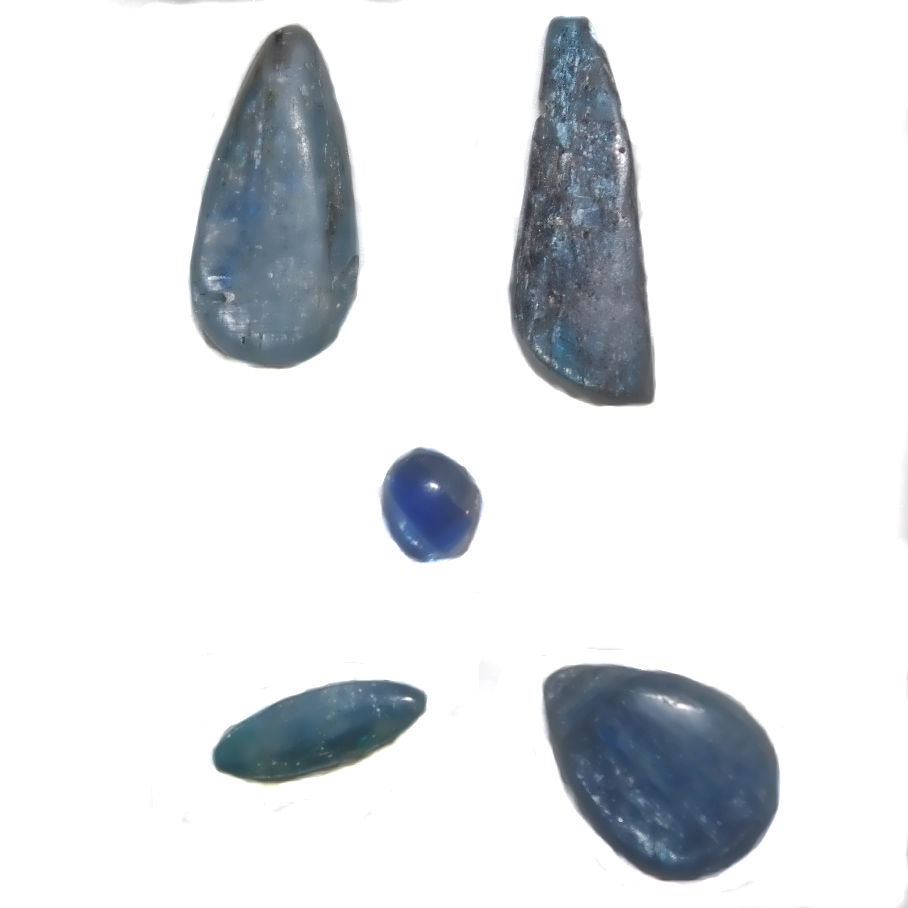
The photos below are different color ranges of Kyanite that I have in my collection.

Monday, April 25, 2011

A Gardening Break

It was so nice this weekend, low 80's with a nice light breeze blowing, that when we went out running errands, I picked up some plants for my flower bed.  I like to add some annuals for color until the perrenials bloom and I have a trellis that needed something on it. I've got some honeysuckle planted there, but it will take a while for it to climb up and I am impatient.

I love my flower bed. It was a birthday present one year. About 50 years ago, there was a house behind the one we live in now. (Rumor has it, it was so high off the ground, cows could walk under it.) The big oak in the backyard got hit by lightening and ended up burning the house down. There was a ton of broken, mossy, cool looking brick around and I had been talking about making a flower bed out of them. So, one birthday weekend, my husband came home with mortar and concrete and I learned out to do brick work. It was a lot of fun and I had a blast.

I used to have Alaska Daisies planted all around the outer border. They were white and had huge blooms on them. The butterflies loved them. Winter before last, the armadillos not only dug them up,  (I'm used to that-rushing out to replant the morning after) but they ate the roots, too. I haven't replaced them, not sure why. I think I got tired of digging them up and dividing them every year. I had run out of room for them. So, I have moved on to the next phase of the flower bed. I have some small, yellow daisies, I think they are called Lamb's Ear Daisy because of the shape of the leaves. They are going to need digging up and dividing this fall. I will use them around the border in place of the white daisies.

Here's a little photo tour of this bed, along with what's old and what's new.
This is a shot of what I think are the Lamb's Ear Daisies. The partial pot in the top left corner is full of Impatiens. I have a ton of those hanging in baskets under the cedar tree in back and they just keep reseeding themselves. Everything that has ever been under those baskets has at least 3 or 4 Impatiens in it. Impatiens are the only thing I really have growing that isn't drought tolerant. Since we seem to be constantly in an extreme drought situation, I've been growing drought tolerant plants for years.


This red beauty is what I got to go on the trellis. It's called Crimson Sun Parasol. I fell in love with it as soon as I saw. It looks like red velvet. It's already clinging to the trellis.


I love Periwinkles. I have some in there every year. They are almost as good at reseeding as the Impatiens, but this year, they haven't started to sprout. I got some in different colors than what I had in there last year. Bright fuschia, and a medium pink. I tried to find some white ones, but nobody had any in stock. I'm good with these, though. I know the butterflies will like them.


I also got a couple more Dianthus (or pinks). They were marked down to .50 because they were so rootbound they were dying. I got a bright pink one and a little white one. I am pretty sure this pink one will make it. The little white one, I don't know. I already had 3 or 4 in assorted shades of pink.These have such a great spicey smell to them. Reminds me of cloves and something else, but I've never been able to figure out what the something else is.


Here's a shot from the end of the flower bed. The tall, sword shaped leaves are Candy Lilies. They are orange and yellow. It's a cross between a day lily and a blackberry lily. Most of the ones you see here have grown from seeds dropped from the flowers. They are a perennial, too . They are fairly cold hardy. The leaves will die back, but not the roots. The flowers come up from the center of the leaves on a skinny stalk and last a couple of days. It's a summer bloomer.  The rust color pot in the back has 9 jade plant leaves in it. I repotted my jade plant a few weeks ago and these fell off, so I stuck them in a pot of dirt. They seem to be surviving so far.


Last, but not least is Lantana. I have always loved this stuff, but never had any. They are sitting in two planters on either side fo the steps. The planters are actually the things that go inside a chimney when you build a house. Can't think of the technical name for it right now. They were "rescued" leftovers from a building site because I though they would make neat planters.  They have a nice mossy patina on them that helps keep the soil moist. They are some sort of unglazed clay/ceramic material and do tend to dry out easily.    I had no idea that Lantana has small, soft thorns on them until I started putting them in the planters.
I hope you enjoyed the tour, If you would like some Candy Lily seeds, let me know and about late August or early Sept., I can send you plenty of them. :)

Friday, April 22, 2011

Turquoise is the Gemstone of the Week

Popular for thousands of years, Turquoise is the gemstone of the week this week. The popularity of this gemstone goes back to the ancient Egyptians and continues up through today. One thing that could account for the popularity is the fact that it is readily available and reasonably priced. Depending on the source, prices per carat can range from $1 to $50. Along with Zircon, it is the birthstone for December.

It is believed that the name, Turquoise, comes from the French word “pierre turquoise” meaning Turkish stone. That is a reference to the fact that Turquoise was brought to Europe from Persia by Turkish traders. For centuries, Persia (Iran) produced the most valuable Turquoise. Now, some Turquoise mined in the Southwestern U.S. compete easily in value. The term Persian Turquoise is used today to refer to stones that do not have the black or brown veining commonly found in U.S. stones.

Turquoise is an aluminum phosphate mineral. Bluer stones have a higher concentration of copper to give it it's coloring while greener stones have a higher concentration of iron or chromium. Since the soil makeup surrounding Turquoise deposits influences color, the location name is often included in the stone name. A perfect example of that is Sleeping Beauty Turquoise from the Sleeping Beauty Mine in Globe, Arizona.


Turquoise is a relatively soft stone-between 5 and 6 on the Moh scale, and is usually enhanced somehow. There are many ways of doing this. I have covered some of the more common processes and names of Turquoise on the market today.
     Foutz Enhanced Turquoise is the name for stones that have been treated by a process that impregnates and hardens the stone with vaporized quartz. This treatment is not detectable by normal testing methods. It is used on high to medium grade stones and will not work on low grade stones.

     Stabilized Turquoise has been treated with a plastic resin that allows lower grade stones to be suitable for using in jewelry.

     Wax treated turquoise works like stabilization and in the past, most Chinese Turquoise was treated this way. Today, most Turquoise from China is resin stablized since they have learned the process.

     Reconstituted Turquoise is mostly all man-made and should be labeled as imitation.

     Compressed nuggets are pieces of Turquoise that are bound with dye and resin. If you cut a piece of compressed Turquoise in half and look at the cross section, you can see the individual pieces of nuggets that were joined together.

     Chalk Turquoise is true, light blue, soft Turquoise that must be stablized to be used in jewelry. Today, there are some dyed stones that are passed off as Chalk Turquoise.

     Imitation and simulated Turquoise are stones that are made or dyed to look like Turquoise. Ceramic, polymer clay, glass and plastic are most often used for imitation Turquoise. Some of the more common stones that are dyed to create simulated Turquoise are Howlite, Magnesite and Dolomite.

     Do your research before you buy so you get what you pay for. Descriptive names are often used despite the chemical composition of the stone.

Turquoise today comes from several sources. In the U.S, Arizona, New Mexico and Nevada are the source. Other sources include, China, Mexico, Tibet, Iran, Peru, Africa, Austraila, Europe and Siberia.


It is believed the Turquoise has many powers. In ancient Persia, it was believe that if the stone changed colors, it was a warning of impending danger. It was often used to ward off the evil eye. Many cultures have held the belief that it is a good luck talisman. It's said that Turquoise enhances self confidence, and provides a sense of unity with one's self. Crystal healers recommend it for detoxifacation from alcohol, poison or radiation.

Here is a link to the Tantalizing Turquoise Collection I curated to go with this post.

Sunday, April 10, 2011

Lapis Lazuli is the Gemstone of the Week

Lapis Lazuli is a deep blue gemstone that often has pyrite inclusions that sparkle like stars. It is a gemstone that has been prized for centuries. The legendary city if Ur, which was on the Euphrates River, is reported to have run a busy trade in lapis as early as 4000 B.C.. While researching lapis for this post, I came across two different meanings of the name. One said it is a combination of the Latin word “lapis” meaning stone and of the word “azul” which is Arabic for blue. The other source said it was Spanish for pencil since some cultures did use Lapis for writing.

Lapis is not a mineral, but a rock. It is composed of grains of several blue stones including sodalite and lazurite. It also has calcite and pyrite in it. If it only had one component, it would be considered a mineral. The deep, rich blue color is from sulphur in the lazurite. It is also flourescent. Lapis lazuli was created millions of years ago during a metamorphosis that turned chalk into marble. In spite of this, on the Moh scale, it has a hardness of 5-5.5, making it a fairly soft stone. It can be easily chipped and scratched, so care must be taken when wearing it. Clean it only with a soft cloth and never use harsh chemicals on it. Some lapis is treated by dyeing it. If you are offered deep blue lapis for a low price, be wary, as it is probably dyed. As will all treatments, this should be disclosed by the seller when purchasing.

Lapis is mined in Afghanistan, Pakistan, Egypt, Canada, Siberia, South America, Chile, and the U.S.. Afghanistan has been a source for lapis for over 6000 years.
Lapis Lazuli was the traditional birthstone of December, but the American Association of Jewelers listed the offical Dec. birthstones  as Turquoise and Blue Zircon as early as 1912.

Lapis is the source of the pigment ultramarine. In ancient times, the Egyptians ground it to make eye shadow, and for paint. It was also carved into seals, vases and small statues. In the Middle Ages, monks ground lapis, mixed it with beeswax, linseed and resin and used it in illuminated manuscripts. Lapis lazuli is one of the gemstones used in commesso, also called florentine mosaics. Commesso was developed in Florence in the late 16th century. It is the fashioning of pictures with brightly colored, thin, cut to shape pieces of semi precious gemstones. Commesso was mainly used for table tops and wall pictures.

Today, lapis is considered to be a stone of friendship and truth. It is believed to help with insomnia and stress. It is said that it aids in helping the aura absorb spiritual energy. Lapis is also said to increase psychic ability.

I am editing this to add that the Amazonite collecton I curated for last weeks' gemstone made it to the front page of Artfire.

Saturday, March 19, 2011

Bloodstone is the Gemstone of the Week

Bloodstone is the traditional birthstone for March and is the gemstone of the week. It is sometimes called Heliotrope which means “sun turning” in Greek. It has also been called the Martyr's Stone. It is a silicon dixoide member of the chalcedony family. The red spots are from deposits of iron oxide. The deep green color is from masses of chlorite. There are two groups of bloodstone-plasma and heliotrope. The plasma group has the dark green color with no red spots. The heliotrope group is more translucent.
On the Moh scale, it has a hardness rating of 6.5-7. Bloodstones that are used in jewelry are sometimes coated with a special polish, so it should not be exposed to harsh chemicals or strong detergents. It should also be protected from extreme temperatures and scratches.
India is the main source of Bloodstone, but it is also found in Brazil, Australia, China and Wyoming. It is a relatively inexpensive stone.

There are a lot of fake bloodstones stones on the market today. To tell a real stone from a fake, rub the stone against a piece of porcelain. If it leaves red streaks, it is real.

This stone was highly prized during the Middle Ages. It was believed that the red spots were the blood of Jesus Christ. It was often used in sculpting statues representing martyrdom. It was also believed that it could stop bleeding with the merest touch. The belief was also held that it strengthened blood purifying organs and improved circulation. It is still finely ground and used today in making traditional medicines in India.
The pictures contain some stones from my gemstone collection.


Thursday, March 10, 2011

Aquamarine is the Gemstone of the Week

Since Aquamarine is my birthstone and the birthstone of those born in March, that is the gemstone for this week.

Aquamarine gets it name from the Latin words for sea and water. The colors range from pale blue to a greenish blue to a deep blue. The deeper the blue, the more valuable the stone. It is an excellent stone for any type of jewelry. On the Moh scale, it is a 7.5-8.


This stone is a member of the beryl family, which is also the family of emerald, goshenite and heliotrope. Aquamarine is the most common member of this family. Beryl is a mineral made up of beryllium aluminum silicate, a commercial source of beryllium. Unlike emeralds, aquamarines are often flawless and ones with visible flaws are rarely seen. Often, the lighter blue aquamarines are mistaken for blue topaz which is not as expensive a stone. Blue zircon is another stone it can be confused with, although aquamarine is a lighter color blue.

The bluest and most valuable stones are mined in Brazil. It is also mined in Kenya, Nigeria, Madagascar, Tanzania, Zambia, Sri Lanka, Pakistan, Afghanistan and the Ural Mountains in Russia.

The most common enhancement for Aquamarines is heat treating. This is done to the paler and more teal colored stones to permanently give a deeper blue color.

Legend has it that sailors used to wear Aquamarine to keep them safe and to ward off seasickness. It is believed to give the wearer foresight, happiness and courage. In the middle ages, it was believed that this stone would reduce the effects of poisons. It is said that this stone will work on healing nerve pain, glandular problems, toothache and it will strengthen the liver and kidneys. It is also said that it will help with depression and grief.

The photos below are Aquamarines that I have. The ring belonged to my mom. Both she and I have March birthdays. The chips are some I picked up, but haven't done anything with yet. The chips are a much deepr blue than the beads, so it's safe tosay that they are heat treated and the beads are not. The ring is old enough to be a natural blue, but I'm not sure  Here is also a link to some pictures of  rough Aquamarine. It holds as much fascination for me as the cut stones do.

Thursday, February 10, 2011

Some gemstone basics

I am going to be highlighting a different gemstone a week in my blog for the next several months, so I thought that before I make the first post, I would do kind of a breakdown on the basics of gemstones and some of the terms used. I know that not everybody who reads and follows my blog creates jewelry. To me, beauty is in the eye of the beholder, so what may appear to be a mediocre looking stone to one person, is absolutely beautiful to another. I think it's all about the color and the pattern in each stone. As with all things created by Mother Nature, no two will ever look alike.

 
Stones are measured on the Moh scale of hardness. This is a scale that was developed in 1812 by mineralogist, Frederich Moh. In researching this series, I have seen his nationality listed as German, French and Austrian. It compares the hardness of one substance against another. It is the most commonly used measure today. Later, the sclerometer was invented and it measures absolute hardness. In the majority of stone listings, though, you will see the hardness as the Moh scale. In this scale, talc is a 1, and a diamond a 10.  The hardness of a stone is an important consideration when designing or purchasing stones. 
You need to be aware that the beautiful piece of coral in that ring is a 3-4 on the Moh scale, and to take care not to bang your hand up against something that could scratch or nick it.

Some of the most common mineral families of stones are beryl, feldspar, and quartz. There are a variety of colors among these families. These variations are caused by the different minerals that happen to be in the stone. For instance, the blue in turquoise is from copper.


Stones are treated in many different ways to enhance or stabilize them. For example, most turquoise on the market today is stabilized to give it more durability and improve the appearance. This is most commonly done with a resin of some sort and is often done with stones that are considered to be somewhat porous. Often stones are heat treated. There are many different way of doing this. It is done to bring out the depth of color. Some stones are irradiated, then heated to further deepen the color. Irradiation of gemstones in the US, is governed by the Nuclear Regulatory Agency to be sure the stones contain no residual radiation. A lot of gemstones are dyed to bring out or change the color, or to enhance the veining. Dyeing is usually followed by some sort of heat treatment to bond the dye with the stone so it won't wear off on the person wearing it. Black onyx is a prime example of dyeing because it does not exist in nature. More on that in another post. There's nothing wrong at all with stones that have been treated. Most sellers of stones or finished jewelry will state in their description that the stone is treated and how. Sometimes they don't know if a stone has been treated, so it's best to proceed on the assumption that it has, in some way, been enhanced.

There is a lot of glass being passed off as gemstones today. Among the most common of these are “opalite”. It's an opal looking glass. Fruity quartzes are another glass stone being passed off as a gemstone. Among these are blueberry and strawberry quartz. They all make lovely jewelry, but they aren't gemstones. If you see a stone or piece of finished jewelry you like, but aren't sure about the 
stone, google it to be sure. The vast majority of handcrafted jewelry makers, including myself, want you to be knowledgeable about your purchase and we want to be knowledgeable about what we sell.

Tuesday, October 19, 2010

Free Photo Editing Software-Photo Pos Pro

I have spent some time looking at free photo editing programs that I have found online. I was looking for something simple and easy to use, besides Picasa, without the learning curve that the Photoshop programs seem to have. I have found a few programs that I like for different reasons and have decided to blog about them because I know I am not the only person looking for these. I am somewhat technically challenged so ease of use in any program is a priority for me. I am not a professional photographer. I consider myself to be an advanced hobbyist. I don't need a ton of bells, whistles and special effect stuff to do my editing.

The camera I have is a Pentax K-X. It's a great digital camera, but I am kind of new to the world of DSLR photography, so I have a lot of test pictures I have taken to get used to the camera and it gives me a lot of material to practice editing with.
The first program I am going to tell you about is Photo Pos Pro .  This program has a lot of hints and tips for editing and I like that. It's an easy program to get around, too.


I used the program to make a banner for my destash studio. I have never made a banner before though I have tried to make one several times. Using Photo Pos Pro, it was easy to do. It took me a couple of hours to create this. I'm happy with it-especially for a first try.


It is also a breeze to use for editing photos. This is one of the test pictures I took to see how the different colors would work with the camera settings I was using and how the lights I was trying in the light box were colored.


You just open the file in the program, go to Colors, and adjust. Cropping and other edits are just as easy to handle with this program.


Photo Pos Pro has a built in Help manual and Tutorials section included with the download. If you are looking for a fairly versatile free editing program, I recommend this one. I like it.

This is just the first of a few programs I have downloaded and will be reviewing. I am not an expert at editing photographs. I will be mostly be giving you my opinions on ease of use, what kinds of bells and whistles they have and what kind of plug ins, if any, are available. I'm hoping it will also help me make up my mind which ones I want to keep. I just can't decide.

Friday, September 17, 2010

Things I forgot to mention about ArtFire

I had been sitting on the previous blog post until I was about to burst, so I published it in a hurry.  I am an ArtFire Maven and had advance knowledge of this announcement. The ArtFire Mavens are a group of sellers who get to play with all the new toys first. Before anything is rolled out to the site, we get to put it through its paces and find any bugs or kinks. We also brainstorm ideas with Admin. on what something should look like or how it should be worded. They are great at listening to and implenting our feedback.

Anyhow, I wanted to mention some more things about why I prefer ArtFire over Etsy.
1. The flat fee. There is no final value fee when something sells, except for whatever percentage the payment processor takes. I like the multiple payment options, too.
2. Admin. there is responsive to problems and bugs. They respond in the forums and one of them, Tony, has even started a thread called Photography Q&A that has grown to many pages. All to help the sellers.
3. Admin, is good about letting you know when and why if the site has to go down for some reason. I think there has been once in the last year that it went down unexpectedly and that was due to severe weather impacting the servers.
4. I like the seller categories. Besides the usual Handmade, Supplies and Vintage, there is a Design category. An example of what goes there is, say, I designed purses, but had 3 of my neighbors making them for me. Still handmade, but not by me, so they go in design.
5. The Collections are similar to etsy treasuries, but a lot different. They will be rotated on the FP of ArtFire, and, if somebody is in a Collection that has made the FP today, if they are in another Collection, it won't be eligble to be on the front page for X (as yet to be determined) number of days. It won't be the same people with the same stuff  showing up time after time, day after day.
6. You can promote yourself in the Collections. It's ok. Some people have made Collections with just their work and that's allowed. Collections are a promotion tool. Google likes them. It is nice to create them with other studios' items. I've found some wonderful shops that way.
7. Pro studios have a gallery where you can show off custom work or work that has sold.
8. ArtFire gives Pro studios a blog that is indexed by google.
9. The flagging system at ArtFire actually works. If somebody is selling something and calling it vintage and it's not, four different studios can flag the item and the item will be removed until admin. checks it out. The sellers is not removed-only the item. If a seller feels items are flagged in error, they can appeal and explain to admin..
10. Last, in this post, but not least, by a long shot. I like the way the site looks. It's getting better every day. I'm not a chrome and glass, owl and cowl kind of person. I'm more English countryside and shabby chic. Barefeet or mocassins over stillettos any day.

If you haven't seen ArtFire yet, click the link at the top of the page. It's worth looking at and who knows, you might decide that for $5.95 a month, its a great deal.

Thursday, March 4, 2010

My blog has new clothes-more or less

I have a new banner for my blog and my Artfire studio and etsy shop. I also have a new avatar for the shops, too.
The wonderful Yini, of Red Ruby on Fire http://www.artfire.com/users/RROFGraphics who has an Artfire studio designed it for me. I was lucky enough to be the recipient of her February blog giveaway and the new banner and avatar are my winnings.

Yini is really easy to work with. If you need a new banner, by all means, contact her. We chatted back and forth by email and I sent her the picture I wanted to use and the above banner is what she created. It's perfect-just what I wanted it to be and so is the avatar. I highly recommend her design work.

Of course, there is a story behind the picture I wanted in my banner. It's a decent sized pond, about 50 yard off of Interstate 95, a few miles north of where we live, but you would never know the highway was that close. The bass that lived in that pond were huge- fun to catch and delicious, too. My husband and I used to go fishing there often. We would see all kinds of wildlife there-hawks, eagles, gators, once a Florida panther even crossed our path. That was cool and a magical moment. We don't fish much in the winter when it's cold-especially in ponds. Don't have much luck with the fish in deepr water. So, several months went by and one nice spring day, we hopped in the car and went up there. We were saddened by what we found. Like so many natural, wonderful areas these days, this mini paradise had been turned into a housing developement. Sadly, we turned around and went home. I wonder what happened to the wildlife. I'm sure the panther was long gone. It had been well over a year since we had seen it-and since seeing it the first time, we would look for tracks when we went fishing.
So that's the story of my new banner picture.

Thursday, August 13, 2009

Selling for a cause

Today's post is going to be about people who are making things to donate to the AGLF. That's the legal fund that is being set up to fight the slander that someone has been blogging about on the internet. I will also post links to those who have been wrongly accused of fraud by this very same blog.
I have a Copper Seed Bead Choker I made that will go to the fund when it sells.Yes, those are real copper seed beads.


Now, on to the links of other goodies for sale for the fund.
First on the list is Gothic Glass on artfire.http://www.artfire.com/modules.php?name=Shop&seller_id=25153
Here is a smashable blogger which can be found in munkinartsshop on etsy
http://www.etsy.com/shop.php?user_id=5529439b I've been informed that this has sold already.
HiloBeads on etsy has some Job's Tears http://www.etsy.com/view_listing.php?listing_id=29167354
Valentine Photograhpy on etsy has a beautiful print for sale for the fund. http://www.etsy.com/view_listing.php?listing_id=29186042

Bad Moon Beads on etsy has this beautiful Pandora style egg Bead http://www.etsy.com/view_listing.php?listing_id=29171032
Another beautiful lampwork bead is from Tracidawn on etsy for the fund http://www.etsy.com/view_listing.php?listing_id=28983156
This Chintz Heart bead by Aricketts on etsy is really neat. http://www.etsy.com/view_listing.php?listing_id=28564879